

Courses taken abroad can count toward the self-designed major requirements, with permission from the student’s self-designed major committee and the CUAR committee.
Tulane offers various study-abroad programs in Israel, Jordan, and Morocco , each offering a wide range of suitable courses. In addition, students can petition to study abroad in a non-Tulane program that may offer suitable courses.
Stacy Mandel Palagye and Keith Palagye Program for Middle East Peace
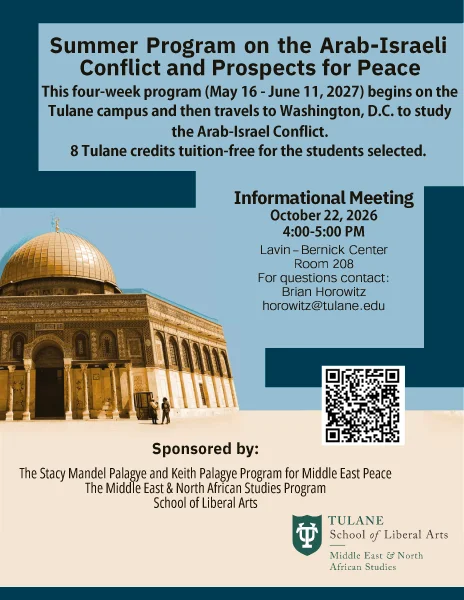
This four-week summer program on the Arab-Israeli Conflict and prospects for peace (May 16–June 11, 2027) will begin on Tulane’s campus and then travel to Washington D.C. to study the Arab-Israeli Conflict.
8 Tulane Credits tuition-free for the students selected. Students will take three summer courses during the New Orleans portion of the program:
MENA 3810: Arab-Israeli Relations: A Historical Perspective
This course provides a historical overview of the Arab-Israeli conflict, from 19th and early 20th century Zionist and Arab nationalist political movements through to the aftermath of the 1967 and 1973 wars. The roles played by religion, land disputes, economic development and external power are addressed, as well as the factors that have pushed the conflict into open conflict and war as well as (occasionally) toward peace.
MENA 3820: Conflict Management in the Context of Israel/Palestine
This course offers an overview of the political dynamics of the Israeli-Palestinian conflict, focusing on events from the First Intifada through to the present day. Topics covered include the Oslo Accords, the Camp David Summit, the First and Second Intifadas, as well as Palestinian and Israeli domestic political developments throughout this time period. By engaging with international relations (IR) frameworks for analyzing conflicts, the course prepares students to study this and other conflicts systematically.
MENA 3830: Israeli-Jewish/Arab-Israeli Peace through Literature & Film
This course explores major themes in Israeli Jewish and Israeli Arab cinema in the context of the social and historical backdrop of the Arab-Israeli conflict. Examining in depth a number of films, the course situates them in the evolution of Israeli and Palestinian cinema. We emphasize current movies (those made over the last decade).
Students will then travel to Washington, D.C. and meet with experts in Middle East studies and visit institutions devoted to diplomacy, journalism and activism.
Students must be 18 by the start of the program in order to apply.
Applications will go live on this page on October 15, 2026.
To learn more, please come to our Information Session October 22, 2026 at 4:00 pm in the Lavin-Bernick Center, Room 208. See you there!
For questions, contact Brian Horowitz: horowitz@tulane.edu.
Sponsored by
- The Stacy Mandel Palagye and Keith Palagye Program for Middle East Peace
- The Middle East & North African Studies Program
- The School of Liberal Arts