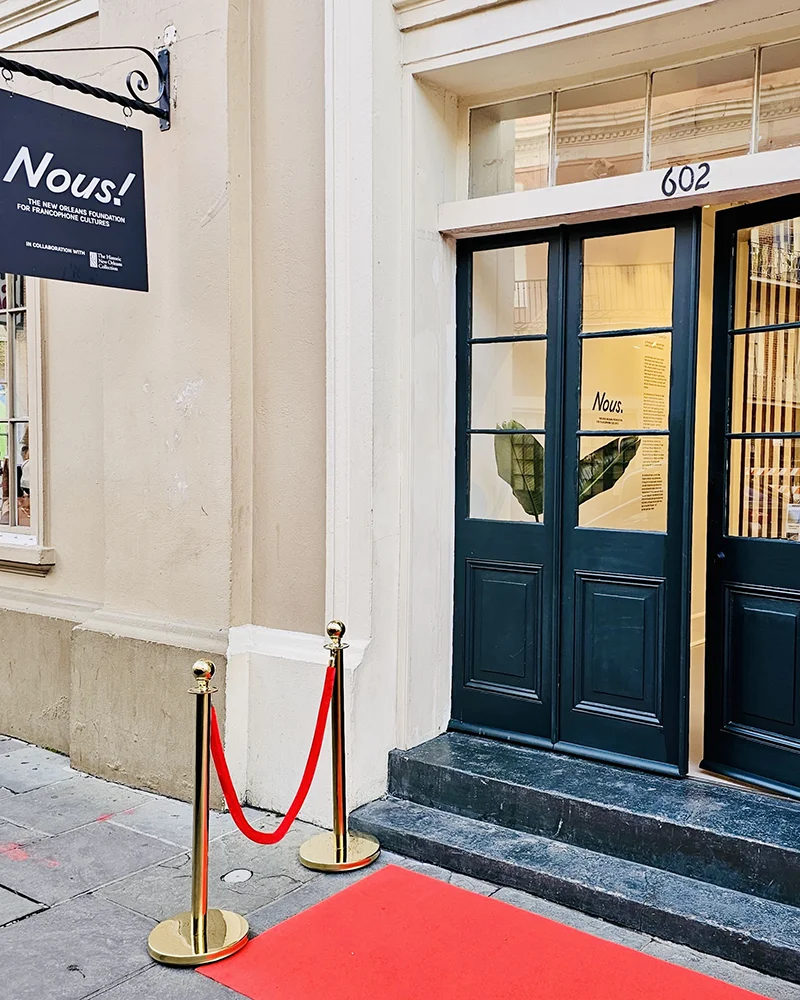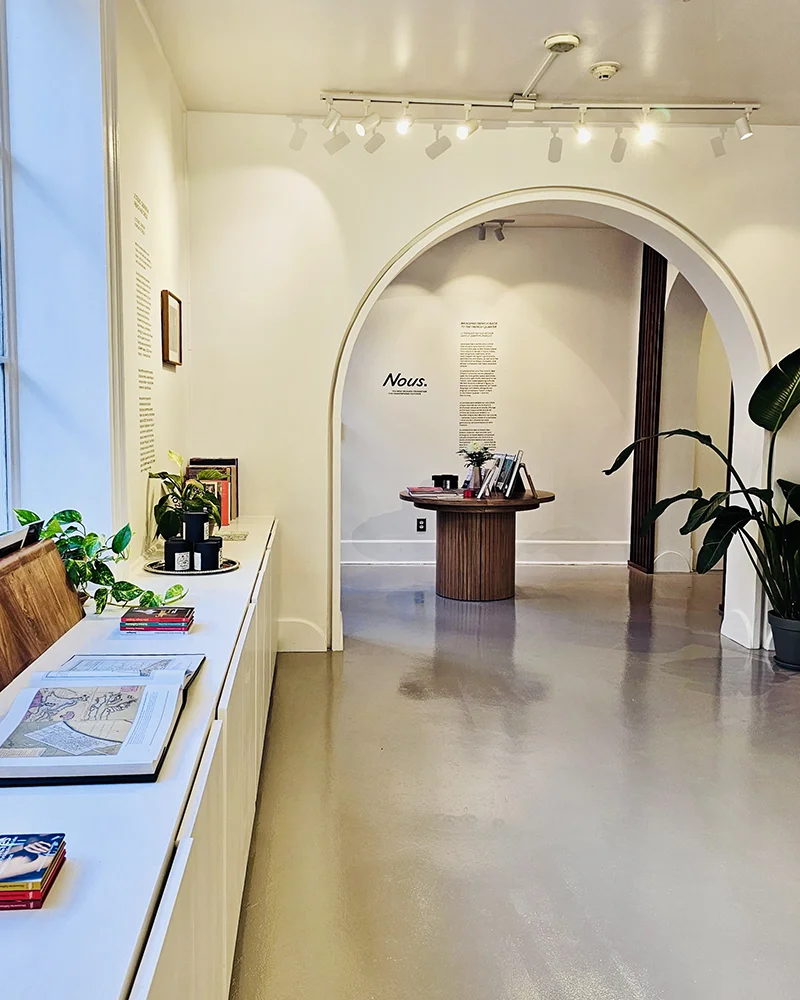
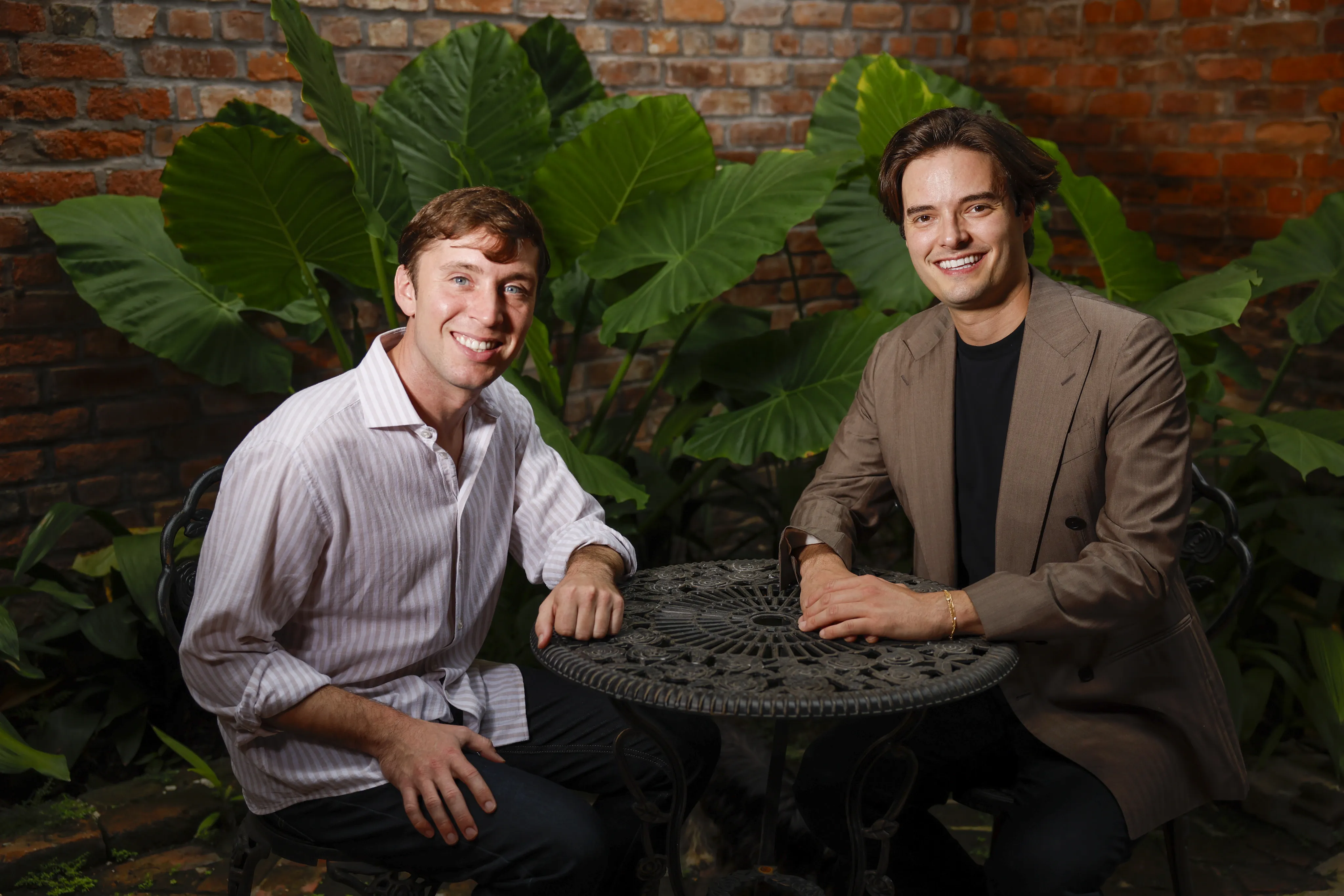
A new bookstore has opened in the heart of the French Quarter, on the corner of Toulouse and Chartres streets — an appropriate location for one of only three French-language bookstores in the United States. The bookstore and gallery space are home to Nous — or the New Orleans Foundation for Francophone Cultures — a nonprofit created and directed by former Tulane Global Humanities Center Fellow Scott Tilton and his partner, Rudy Bazenet.
“We like to joke that we are bringing French back to the French Quarter,” says Tilton, who grew up in New Orleans and is of French-Creole descent. He met Bazenet — who hails from Clermont-Ferrand, France — while they were working in Paris. There, they launched an initiative to have Louisiana join the International Organization of la Francophonie, a global body that connects French-speaking countries and regions.
The pair moved back to New Orleans in 2021; their first project stateside was supported by a Monroe Fellowship from Tulane’s Global Humanities Center. The fellowship funded Voices of Renewal, a video project documenting the revitalization of Creole heritage in communities facing environmental crisis along Louisiana’s rapidly eroding coastlines.
Those early efforts laid the groundwork for Nous, whose mission is to revitalize Louisiana’s heritage cultures, including Cajun/French, Creole, and Indigenous communities.
“From the beginning, we knew that having a physical location where people could come and learn about these cultures was important,” says Tilton. The Toulouse Street location is also a gallery, office space, and studio for producing print and audio projects.
For the bookstore, they aimed for a mix of international and Louisiana-focused French material: shelves hold around 300 French classics alongside art and history books, exhibition catalogs from the Louvre and museums in Quebec and Switzerland, as well as fiction written by Louisiana authors in French — most dating back to the 19th century — along with more contemporary works.
“As recently as 1970, there were about a million French speakers in Louisiana,” says Tilton, which would have represented about 1 in 3 people. “Today, there has been a near 90 percent drop, with only about 150,000.”
Louisiana Creole — distinct from French dialects, in that it blends French with West African and Indigenous linguistic traditions — is a critically endangered language, with fewer than 10,000 active speakers. Tilton’s own connection to Louisiana’s Francophone heritage began at home. His Grand-mère and great uncle were part of the state’s French-speaking traditions, but it wasn’t until after Hurricane Katrina, when Tilton was a teenager, that his father began teaching him French more intentionally. Around the same time, Tilton’s family moved to the French Quarter, where neighbors who spoke Creole welcomed the opportunity to teach him that language as well.
The experience left a lasting impression.
“In Louisiana, teaching French and Creole was actually banned for a while — from 1921 to 1974. Even in my family, while they’re proud of being French-speaking, there were spaces where they didn’t want to use it publicly. That came from a sense of shame around speaking the language, and I became very aware of that growing up.”
In addition to French and Creole traditions, Nous collaborates with Indigenous language initiatives, including the Houma Language Project. A recent effort launched a grant program supporting work in Sabine Parish on the revitalization of the Mobilian language.
Since 2021, Nous has grown rapidly. The foundation has received multiple major grants, including two active grants from the National Endowment for the Humanities (NEH) and a recent grant from the Mellon Foundation. They’ve also had several Tulane interns over the years, both through the French department and service-learning initiatives, who help with events, programs, and community outreach.
A major current project focuses on building a digital archive for materials related to Louisiana’s heritage cultures that are at risk of being lost. The pair is working with scholar Kim Vaz-Deville, whose research includes searching funerary archives for materials that reference heritage cultures.
“People have literally been giving us hundreds and hundreds of documents,” Tilton says of their initial outreach. Seeing this need helped kick-start the project, which is now funded by a Mellon grant.
Their NEH grants are connected to Celebrate America, commemorating the country at 250.
“We wanted to flip the narrative on Louisiana always being on the periphery of the show — so we’ve organized this season to be about Louisiana’s America. The idea is to show how we influenced the country in return,” explains Tilton.
The first exhibition launches with a sold-out symposium, organized in partnership with The Historic New Orleans Collection, titled "One Single Place: Louisiana and the Shaping of the Early American Republic," held March 20–21 at the Nous space. The event features School of Liberal Arts professor Walter Isaacson as the keynote speaker.
Opening April 8, the exhibition, "Becoming Louisiana: Borders in Motion (1688–1812)," traces the shifting geography of the region through historical maps, telling the story of how Louisiana emerged as a territory. Their second NEH grant will support a later exhibition on the reception and interpretation of the American Revolution in Louisiana’s French-speaking communities. “We wanted to focus on the perception of the Declaration of Independence, but in light of other revolutions that were going on — the Haitian Revolution and the French Revolution — and how Louisiana was being influenced from all of these different directions,” Bazenet explains.
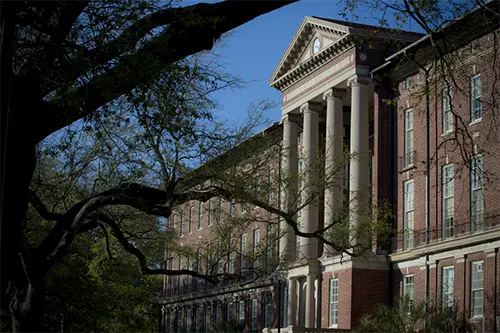
Bazenet is lead curator for both exhibitions. He was also recently accepted to Tulane’s PhD Program in French Studies, where he plans to work with School of Liberal Arts Associate Professor Chelsea Steiber, director of Graduate Studies and a scholar of Haitian 19th-century literature. At Tulane, Bazenet aims to hone the archival skills essential for his role in the expanding space and foundation.
“We do a lot of curation — exhibitions, publications, films — and that requires increasing amounts of research,” says Bazenet, whose focus will be on the French and Haitian Revolutions in Louisiana.
Working with Stieber, he will continue developing the research methods necessary for archival work while applying them directly to the foundation’s public-facing projects in their French Quarter location — a place where scholarship and community engagement meet. “Come visit us anytime,” says Tilton.