
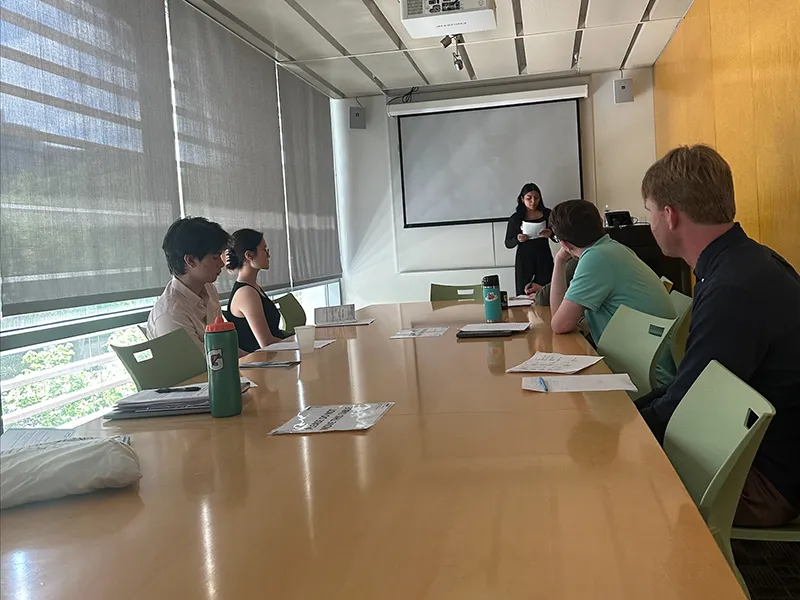
Undergraduate students recently spread across three rooms in the Lavin Bernick Center for University Life to present their research. The students argued over major topics such as technology and identity, late-stage capitalist messaging, and the aftershocks of trauma. The English Undergraduate Research Conference convened students to discuss everything from the colonial history of Russia to press censorship put in place by the Bangladeshi government. Each presentation proved that literary scholarship is a discipline that has never stayed on a page, but is rather a dynamic opportunity to facilitate conversation.
The annual conference began with the goal of showcasing the literary scholarship of first-year writers, but it soon became an opportunity to share student work across the entire department. However, the focus remains on giving early undergraduates opportunities they might not otherwise have had this early in their time at Tulane.
Professor of Practice Matthew Sumpter, faculty director of the Writing Center at Tulane University and organizer of the conference, discussed the strong support system that Tulane undergraduates have within this educational event. “The Freshman Writing Program at Tulane punches above our weight. Our instructors are engaged pedagogues who love working with students, and we're amazed year after year at the brilliance of Tulane undergrads.”
He shared his excitement at the wide range of topics undergraduate students explored within their research. He described this as an enriching experience for participants, as it facilitates a spirit of passionate discovery of the individual human experience. “This year's cohort featured more literature papers than in the past, which was so fun, because we got to see, for example, a paper examining diaspora and non-linear time in the work of Ocean Vuong, alongside a paper examining the geopolitics of the Russian empire. A literary perspective deepens and enriches a discussion of any topic by focusing on how lived experience, language, and narrative determine what the world means to us,” he explained.
Freshman Max Rinnander discussed the inequities of the test-required college admissions process. His research drew on data showing that New Orleans students' stress levels rose by 15 percent during standardized testing periods. Rinnander argued that both the ACT and SAT are intertwined with socioeconomic status, and a student's access to testing preparation materials, support networks, and tutors increases their chances of scoring higher on standardized tests. Rinnander’s policy prescriptions were not exclusive to testing alone. He made sure to address the root issue of the problem: “Conversations must begin by acknowledging that tests exist within a broader social context that affects performance.”
William Larson explored the topic of Soviet Russian Colonialism within his wider theme of Art and Politics in East Asia. His research examined how language and religious suppression were utilized on the European continent across Soviet-Controlled nations. Using the example of Latvia, Larson traced both the linguistic and religious consequences of oppression. He discussed the transitions between Orthodoxy in Pre-Bolshevik Russia and forced atheism after the Bolshevik Revolution. His work challenged the assertion that colonialism existed exclusively in Western European, Christian-dominated countries. Pointing to the oppression faced by Ukraine, Azerbaijan, Armenia, Georgia, and the Baltics, Larson showcased how religious and cultural dismantling destroys identity.
Tasfia Ahmed, a freshman and Altman Scholar, also discussed dismantling a national identity. Ahmed’s research traced a cultural and linguistic destruction with the Bangladeshi democracy. She explored how the enforcement of Urdu on Bangladeshi citizens, as well as religious tensions between Hindu and Muslim movements, created a framework for colonial control. Her presentation moved through the regime of the Sheikh Hasina and the Digital Security Act, the targeting of journalists through censorship and limitations on free speech, and the July 2024 revolution.
Newcomb Scholar Carlotta Harold was among the seniors presenting their honors thesis. Her thesis examined historical romance novels that featured marginalized characters. Among the stories she researched, characters included two black characters in Reconstruction Era, two Latina lesbians in 1889 Paris, a transgender woman and a disabled man. She interrogated how authors navigate history to craft compelling narratives. “Romance is such a besmirched genre, and I wanted to do a little bit of work that would fight against that.”
She explained that authors within the genre of historical romance are doing serious archival work that deserves recognition for its attention to detail and accuracy. Harold’s interest in this subject was sparked by Adrianna Herrera’s novel An Island Princess Starts a Scandal, and was further molded by her thesis advisors. One such advisor, Assistant Professor of English and Spanish & Portuguese Zorimar Rivera-Montes, was a foundational mentor for Harold in discovering how to utilize her passion in the realm of research. She describes Rivera-Montes as a force for support. “At no point was she like, ‘this is a stupid thing to analyze,’ exactly the opposite, she took it very seriously.”
Furthermore, professors in Gender & Sexuality Studies and Africana Studies helped Harold shape her worldview. She shared that Assistant Professor of Sociology and Africana Studies Corey Miles’ instruction to “think otherwise” inspired her journey to pursue interdisciplinary studies within the School of Liberal Arts. Harold’s work is as interdisciplinary as it is timely. With the histories and representations of marginalized people being actively erased, Harold’s work is a vital reminder of the wealth of ways in which expression and advocacy are available. To students interested in research, she advises: “Passion is the number one most important thing in research.”
The English Undergraduate Research Conference is a reminder of the opportunities students have within the School of Liberal Arts. The English Department has equipped Tulane students with the knowledge, capabilities, and skills to present research that is pertinent to the times and expresses their individual interests and passions in a way that sets them up for future success. Students don’t have to wait until they are upperclassmen or graduate students to explore relevant questions. Even freshman are encouraged to dive deeply into all of their overlapping interests to find meaningful solutions.