

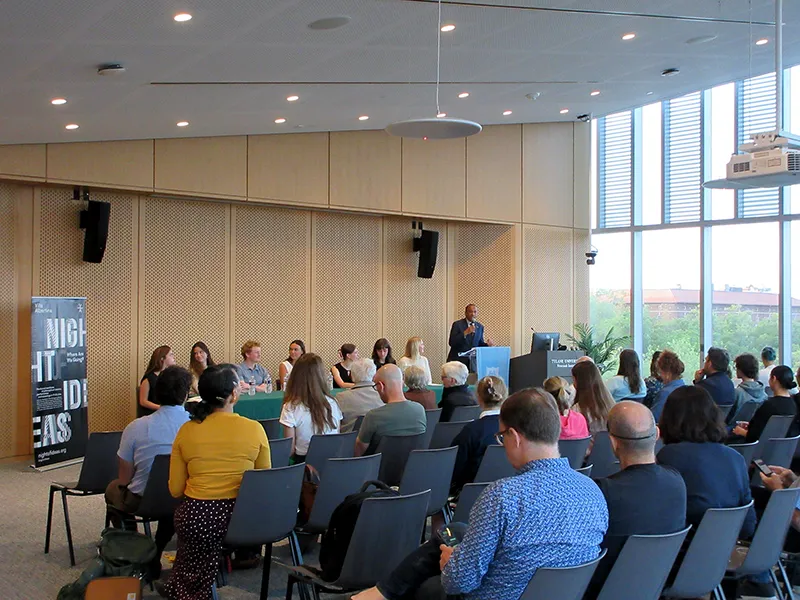
Tulane University recently joined institutions from across the world in hosting La Nuit des Idées, an annual event that invites thinkers, students, diplomatic figures, and public voices to discuss a shared question and celebrate the free circulation of ideas and knowledge. This year’s event was themed Opening the Way — particularly for younger generations, new solutions, and innovative tech — while keeping the ideals of Enlightenment writers at the center of discussion.
Featuring eight graduating students with degrees in French and a variety of other fields, the discussion centered on the legacy, contradictions, and relevance of the Enlightenment to a world that is seemingly, in many ways, coming apart at the seams. The graduating class guided attendees through presentations of the questions they aim to answer in their senior seminar project, making it clear that the Enlightenment is not a chapter that has been closed. It is “an unfinished book,” as phrased by Mr. Rodolphe Sambou, Consul General of the French Republic in New Orleans.
The night began with remarks from Mr. Sambou, who framed the dangers of a world in which Enlightenment ideals are not upheld with a precise call to action, explaining that it “is not about triumphant faith in progress. It is about maintaining a society’s capacity to criticize itself and resist all forms of dogmatism.” In an increasingly polarized world, he argued, the continuous return to the ideal that every person has the capacity and the obligation to think for themselves is not a historical inquiry but rather an analysis through a modern lens. The presenters reinforced Mr. Sambou’s call to action through innovative applications of the ideas.
Carey Bass (SLA '26) and Aviva Blumenthal (SLA '26) opened with what might be the Enlightenment’s most uncomfortable truth: At its foundation, documents promised universal freedom while defining “universal” in the narrowest possible terms, to that of a wealthy white man. Jefferson owned hundreds of enslaved people when he wrote: “All men possessed unalienable rights.”
In fact, “The Declaration of the Rights of Man and of the Citizen” was drafted by men who had no intention of letting it cross the Atlantic to Africa. Bass and Blumenthal’s presentations highlighted that the ideals were real, but so was the machinery designed to ensure they applied to as few people as possible.
Charlotte Olson (B and SLA '26) and Mary Evelyne White (SLA '26) traced how the ideas of the Enlightenment were delivered through the same ships as goods, enslaved people, and rumors, and how the communities those ideas were designed to exclude became the ones who actually took them most seriously. Enslaved people in Saint-Domingue didn’t wait for philosophers to extend their freedom to them but read, organized, and revolted on their own accord, morphing these ideas into revolutionary action. The Haitian Revolution, as both presenters made clear, was not a distortion of Enlightenment ideals, but rather their most radical and honest application. Abolition didn’t come from abolitionist philosophy but from the people who had been excluded from the American experiment.
Gaston Finger (SLA '26) pushed this idea further with his presentation, offering a unique analysis of the way that history is remembered. Finger highlighted the selective application in the way that we define violence by comparing the Haitian revolutionary leader Jean-Jacques Dessalines, known for being brutally violent, with the legacies of George Washington and Napoleon, who both led through profound violence. Finger suggested that Haiti’s existence was more than a political inconvenience to colonial powers. It was an ideological threat. Dessalines wasn’t exiled from the Enlightenment canon because he went too far, but “because he was never supposed to be part of it at all.”
Nina Zimmermann (SLA '26) made a case for virtue as something conspicuously absent from contemporary political life. The definition of virtue proved fertile ground for discussion. The evening event shifted into open discussion between the panel, audience, and presenting students. Alexis Smith traced the line from the Reformation through humanism to the present, asking what happens when the shared ideals, on which both France and the US are founded, collapse? The audience offered insights into disinformation and extremism, disguised as conviction, among other topics. White noted that it has never been harder to stop ideas from circulating than it is today, while simultaneously being the easiest time in history to corrupt them while in transit.
The event itself, as noted by Mr. Sambou, was an active example of what the Enlightenment looks like in practice, within today’s context. Not a top-down fixed set of values established among elites, but a commitment to critical thought as an ongoing, collective act. In a moment when that commitment is under pressure from every direction, an evening like this one is a small but genuine reminder of the importance of maintaining incubators for dialogue, tolerance, freedom, human rights, and the rule of law.
The event was made possible by the Consulate General of France in New Orleans, Villa Albertine, the Tulane Department of French and Italian, America 250, and the guest judge panelists who joined for the evening.