
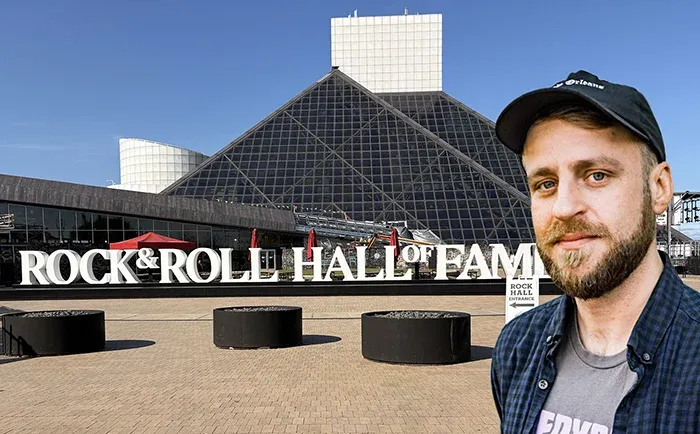
Music and Gender & Sexuality Studies Lecturer Kyle DeCoste brought his research on country rap to the Rock & Roll Hall of Fame as part of the American Musicological Society’s lecture series, joining collaborator Alex Blue V to examine how the genre challenges conventional ideas about race, place and musical identity. In this edition of 7 Questions, DeCoste explores what country rap reveals about American culture, how firsthand research shapes his scholarship and why popular music offers a powerful lens for understanding the world around us.
1. What drew you to the country rap genre, and what does it reveal about race and place in the United States?
I was first drawn to the genre when my collaborator, Alex Blue V, showed me a country rap video while we were roommates at a conference. It was a hip-hop video that was explicitly anti-urban in its lyrics and featured white people in a rural setting drinking moonshine and dancing on the back of pickup trucks. It paired white rural imagery with an imagined Black urban sound and had many millions of views on YouTube.
Neither Alex nor I had any idea what was going on, which made it super appealing for further study — it was really directly addressing ideas about race, place, and genre. As an interracial duo, Alex and I were especially interested in talking through country rap media because it gave us a chance to pick apart whiteness and Blackness and their constitution through sound.
2. Your scholarship considers questions of race, place, class, gender and identity through popular music. What have you encountered in your work that has changed or complicated the way you think about country rap?
At first blush, country rap might seem extremely novel — and I think a lot of people encounter it that way, with a kind of shock value. And it’s true that it crosses racial lines in music genres in ways that are seldom seen and heard in mainstream popular music. But the story of country rap is also the story of popular music in the United States. Like many other genres, country rap can tell us a lot about the expropriation of Black music and creative labor from Black people. We encounter things daily on social media that put our understandings of country rap into question. I think, methodologically, Alex and I also really benefit from writing collaboratively. Our conversations and writing sessions are endlessly exciting, and we’re always learning new stuff together.
3. Country rap is often described as a blend of country and hip-hop. What do we miss about the genre when we stop at that definition, and what emerges when we consider its broader cultural context?
Country rap is a distinct genre shaped by mutually enforcing and contested notions of the rural and urban, Blackness and whiteness, authenticity and inauthenticity. If we were to think of it as purely a hybrid genre, I think the tendency is to view it in a kind of racially utopic way where country and hip-hop and Black artists and white artists are coming together, sometimes with class solidarity as the main unifier.
But it’s actually much more complicated than that. A lot of these artists are white and lean into ideas about white nationalism or neo-confederate politics in their music, which I think a lot of people, myself included, would see as contradictory when paired with a Black musical tradition like hip-hop. And a lot of audience members are encountering this music through algorithms that push white artists more than Black artists. Often, the outrage economy is working to circulate music by white artists more than that by Black artists.
4. Your work involves spending time with the people and communities connected to the music you study. How does that firsthand perspective shape the stories you’re able to tell about popular music?
Ethnography is an extremely valuable tool in research. It’s rooted in storytelling, which carries a lot of rhetorical power when communicating with an audience. I’m trained in Black feminist methods where lived experience is absolutely seen as a valuable tool for having knowledge about something (rather than something that brings your objectivity into question). I was also born and raised in a small town in Canada, where my mom knew virtually everybody in town, and I think I carry some of that small-town approach with me when I’m doing ethnography.
I love meeting people and hearing what they have to say about the world. One of the joys of my life is getting to spend time with people who make, care for, and love music. It might be driving through town listening to music with musicians, or spending time with bands in recording studios, or bringing artists into class, or simply going out to a live performance. All of those experiences — even if they’re not explicitly written about — inform my work and help me ground critical theory.
5. You’re also working on a history of the Original Pinettes Brass Band through a Black feminist lens. How does working across different musical communities influence the questions you find yourself asking?
Some projects are more collaborative than others, and they all have different motivating questions. The Pinettes are a New Orleans institution, one of the premier brass bands in New Orleans, and the only all-woman brass band in the city. I’ve worked closely with them for years in an effort to write them into history and to make explicit the critiques that they bring to a male-dominated instrumental genre like brass band music.
It differs a lot from the country rap scene because, with country rap, I’m not fully immersed in it in the sense that I’m not helping to produce albums or doing any collaborative writing with country rap artists. Country rap is also a genre that takes place in a bunch of different communities and locations, whereas brass band music — at least the brass band music I write about — tends to be based here in New Orleans.
I do think there are questions that extend across my various projects. I’m really interested in how race and gender are articulated across genres and within scenes. I tend to perseverate when I’m writing, so I find questions might stick with me and influence the ways that I’m thinking about multiple ongoing projects.
6. You teach in both Music and Gender & Sexuality Studies at Tulane. How do the ideas you’re exploring in your scholarship make their way into your classroom?
The classroom is a natural extension of the work I’m doing. I’ve assigned my work in my classes-sometimes when it was still in draft form. I find teaching my own work to be really rewarding because it allows me to give insights into the work behind a published piece in ways that I couldn’t otherwise do. And offering in-process work to students also helps to shape it and understand what is coming across clearly and what might need some more work. I teach my Music and Gender class like a seminar, and I find it to be one of the best environments for exploring ideas. Bridging teaching and research just makes sense. I couldn’t imagine researching and writing in a vacuum, and the classroom setting forces me to share works-in-progress and gives students a chance to help shape the conversation.
7. What do you hope students take away from studying popular music — especially music they may already listen to or have strong opinions about — beyond simply learning more about the music itself?
I really hope students listen deeply and listen better — to music and to each other. If they can leave my classes thinking about popular music in their own lives in critical ways, I think that’s a fantastic outcome because that’s something that stays with you. Centering popular music as an object of analysis opens up a whole bunch of different avenues not just for making sense of the world, but also for imagining what we’d like the world to be. If I can help students question and make sense of the world we live in, I think I’m doing what I should be doing.