

Innovations in the way we teach language reflect a quickly changing world
From designing games to integrating AI, Tulane language professors are embracing new methodologies and technologies to update how students learn languages and decrease anxiety. More essential than any one tool or platform are the shifts in language learning philosophy that underpin these innovations. In a world where translation tools are readily available, these approaches emphasize the true values of language learning: taking risks, cultural exchange, competent communication, and the many ways learning a language teaches students how to learn anything at all.
“There are a million [digital] translators out there,” says Senior Professor of Practice in the Department of Spanish & Portuguese Brittany Kennedy, who sees recent updates to the Spanish curriculum as a paradigm shift in language learning in the age of AI. Through an emphasis on metacognition, she says, instructors are showing students that “learning a language doesn't just teach you a language, but it teaches you how you learn things.”
“This lesson is so important for students as they transition to college-level work,” Kennedy adds, noting that her students consistently report how strategies around language processing and higher order thinking carry over into their other classes.
“For me, it comes down to the value of learning how to think and perform, not just learning discrete tools,” says Megwen Loveless, Senior Professor of Practice and Director of the Portuguese Basic Language Program. As in other liberal arts disciplines, she believes that learning how to work creatively and efficiently with what’s at hand matters more than mastering any single resource. At the same time, she designs a curriculum that equips students with a wide range of tools and techniques. Still, she emphasizes: “It’s about learning how to use a toolkit, not just memorizing the tools themselves.”
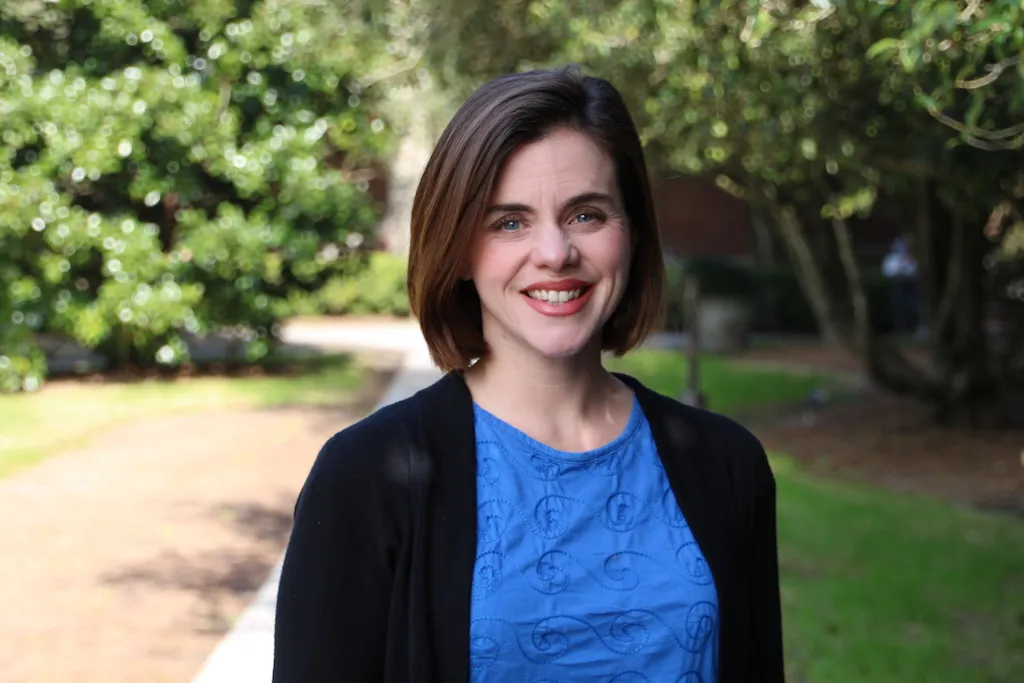
Megwen Loveless, Senior Professor of Practice and Director of the Portuguese Basic Language Program.
AI, Telecollaboration, and the Art of Conversation
Anyone who has tried to speak a foreign language knows that perfect grammar means little if you are too anxious to open your mouth. Loveless builds her curriculum around this reality, as well as the broader pressures students face. To create the foundation for confident communication, language instructors are placing renewed emphasis on one-on-one conversation practice — sometimes with people, sometimes with AI.
In the Spanish program, the shift to digital learning includes integrating language coaches through a service called LinguaMeeting. Native-speaking coaches from around the world meet with students throughout the semester, offering feedback and tailoring conversations to course content.
To build students’ confidence to engage in these real interactions, instructors incorporate AI tools such as Speakology and TalkPal. After practicing with AI, students in Portuguese courses participate in monthly telecollaboration calls with partners in Brazil. The semester often culminates in interviews with native speakers on campus — an experience Loveless sees as the final step in a carefully scaffolded process.
While human interaction remains the ultimate goal, AI plays a meaningful supporting role. Charles Mignot, Senior Professor of Practice in the French & Italian Department, uses Speakology to provide students “tutors at hand,” even if they cannot fully replicate the nuance of real cultural exchange. He also appreciates the immediate feedback that AI exercises can provide, noting that timely correction is an essential component of the language classroom. “It is not perfect,” says Mignot, “but it’s a solid alternative.”
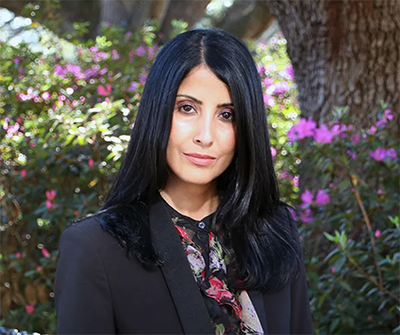
Abeer Al-Mohsen, assistant director of Language Education at the Language Learning Center (LLC).
Last semester, Abeer Al-Mohsen, assistant director of Language Education at the Language Learning Center (LLC), integrated TalkPal into an intermediate Arabic course and conducted a study on its impact. Students who completed the personalized, interactive exercises created by the AI-powered platform reported increased confidence in speaking, along with moderate to high gains in pronunciation, listening, and overall engagement. At the same time, students identified areas for improvement, including topic shifts, speech recognition, and feedback accuracy — insights that will help refine future use.
These tools often accompany curricula that have moved to fully digital platforms. Both the Spanish and Portuguese programs use an Open Educational Resource (OER) model, which allows students to access course materials for free and on-demand. In a digital environment, students can complete exercises independently, repeat them as needed, and receive immediate feedback through built-in answer keys.
In the Portuguese program, Loveless collaborated with graduate students from the Stone Center for Latin American Studies to develop and build a digital curriculum. In the process, those students gained valuable experience in HTML and course design — skills that translate directly to the academic and non-academic job market.
Accessibility is also central to the School of Liberal Arts’ Language Learning Center (LLC), which serves as both a support system and an evolving archive of pedagogical resources. Projects like Français à la Nouvelle-Orléans, developed through the French department and the LLC, extend this accessibility even further, offering a beginner-level digital French curriculum that is available not only to Tulane students, but to the public.
Analog For the Win
While AI tools are rapidly advancing, unplugged methods continue to work, as long as they capture students’ imagination. “I really believe in ludic learning, where the joy of the activity — the game — overpowers the anxiety about ‘getting it right,’” says Loveless, who incorporates music and gameplay into her teaching wherever possible.
Graduate students from the Stone Center also worked with Loveless to develop professionally produced, Taboo-style card games that reinforce vocabulary and concepts. As students play, they often become so focused on the task that they forget they are practicing Portuguese.
The goal is to build what Loveless calls “strategic competence:” the ability to communicate even when you don’t know the exact word.
In many of her Portuguese and Spanish classes, a single song anchors an entire lesson. Students begin by learning about the artist and their country of origin, then move into close reading of lyrics, followed by grammar-based and communicative activities. Within one lesson, they practice listening, speaking, reading, and writing — all within a framework that feels engaging and memorable.
“The music is the gimmick; the language is the gift,” Loveless says.
Similarly, the Spanish program offers flexible, topic-driven courses that allow students to learn language through specific interests. Kennedy teaches a course titled “Witches, Bad Bitches, and Femme Fatales,” while Senior Professor of Practice Amy George offers “Contemporary Indigenous Voices.”
“When you’re learning a language, you will inevitably forget the word you need. If you can use circumlocution — talking around the word — that’s often more valuable than raw memorization.”
The “Ungrading” Method
Loveless has also innovated how she marks progress. Her “Ungrading method” doesn’t eliminate grades entirely, but reframes them around growth over time. A student might take an open-book quiz, review the correct answers, and later revisit the same material in a closed setting. In more advanced courses, Loveless often uses the “Not Yet” approach: an answer may not be correct — yet — but there is time to improve.
Rather than aiming for perfection, her rubric emphasizes 80 percent proficiency as a meaningful benchmark. This, she explains, not only relieves anxiety but more closely reflects real-world communication.
“I tell students: if you can communicate 80 percent correctly with a native speaker, that speaker will usually understand you based on content, body language, facial expression, and context. If I say, ‘Yesterday I buy cereals at market,’ you still understand I bought cereal yesterday at a market, even though the grammar isn’t perfect. That’s the benchmark we’re aiming for.”
“What matters is that they learn the content by the end of the semester. If it’s hard the first time, they can study again and take another quiz during office hours. We celebrate mistakes; that’s how learning happens.”
The message is clear: reach the threshold for meaningful communication, and build from there. Students revise and resubmit — sometimes multiple times — until they meet that benchmark.
In the Spanish program, Kennedy and her colleagues incorporate similar ideas through ungraded projects that emphasize reflection. In courses like “Advanced Spanish in Context,” students complete one or two projects where they receive credit for documenting their process — how they gather information, think through language, and present their ideas.
“I think reflection is going to be a big part of our program moving forward,” Kennedy says.
Looking Ahead
The LLC offers outreach to language faculty in order to integrate new practices into their classrooms and consider others. Al-Mohsen sees efforts like the TalkPal beta-testing in her Arabic class as part of a broader commitment to innovation in language pedagogy.
“The pilot reflects the LLC’s commitment to leveraging emerging technologies to enrich language learning experiences,” she says. “The findings will guide future decisions on integrating AI-based tools into asynchronous components across language programs.”
Recently the Center for Engaged Learning & Teaching and the Innovative Learning Center hosted a training session focused on AI in language teaching, offering faculty practical strategies for incorporating these tools into their classrooms.
Like Al-Mohsen, Loveless sees the Portuguese program as a testing ground for new ideas — an environment where approaches can be piloted, refined, and eventually expanded.
More than anything, she emphasizes, the most meaningful transformation is philosophical.
“I often say: What good is a liberal arts education if you don’t have the flexibility, creativity, and wherewithal to use it in different contexts?” she says. “We apply that idea to many disciplines; it makes just as much sense in language learning as it does in writing or other fields.”