
Music Industries and SLAM Professor Taku Hirano Wins Berklee’s Alumni Achievement Award, releases solo album, and more
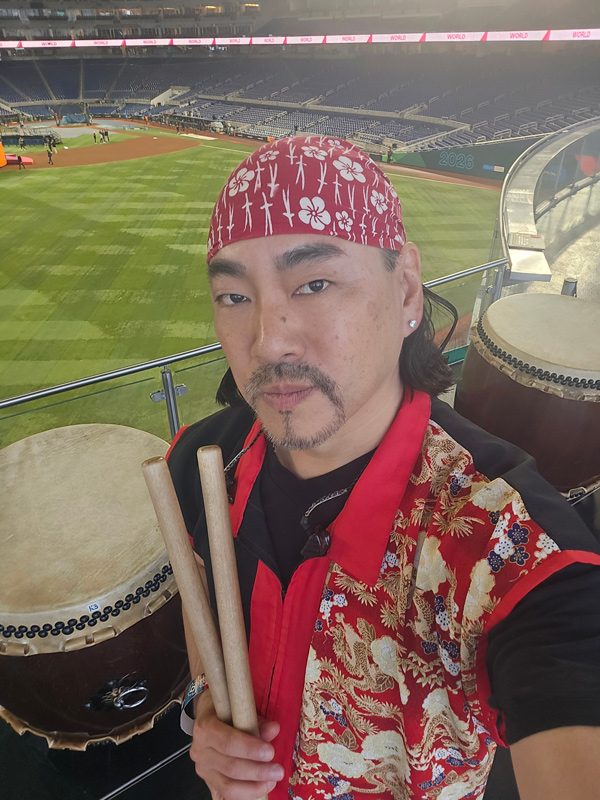
Taku Hirano has a lot to celebrate: In just a few weeks, the rock star percussionist — and Professor of Practice in Music Industry Studies and the Strategy, Leadership, and Analytics Minor (SLAM) — accepted an alumni achievement award at his alma mater, performed at the MLB world games, released the 15th anniversary edition of his signature Hand-Bale instrument, and dropped a new album, Crystal Forest. We caught up with him to reflect on these milestones, his work with traditional taiko drums, composing ambient music with intention, and how it all feeds back into his teaching.
1. How does it feel to have so many major milestones converge at once?
It’s a convergence that took a long time to build. The album, the award, the World Baseball Classic performance, the Hand-Bale release — none of these happened overnight, and none of them are unrelated. They each connect back to decades of work across different areas of the music industry.
What feels most satisfying is that the breadth of the career is being recognized, not just one piece of it. I've never had a single-lane career, and for a long time that wasn't always understood as a strength. Moments like this suggest it is.
2. You graduated from Berklee School of Music in 1995 and then returned more recently to earn a master’s in Music Business. From being Berklee’s first-hand percussion principal to earning a master’s nearly 30 years later — and now receiving the Alumni Achievement Award — how do you reflect on that full-circle journey?
Honestly, it caught me off guard. To receive this recognition alongside the alumni legacy of GRAMMY-winning artists like Branford Marsalis, Lalah Hathaway, and Charlie Puth — and for work that spans performance, recording, education, music business, and my graduate research — was genuinely heartening. It felt like an acknowledgment that a career doesn't have to follow one lane to matter.
Berklee truly equipped me to be a modern working musician. Beyond private lessons in jazz drumming and hand percussion traditions from Cuba, Brazil, West Africa, India, and North Africa, I was essentially thrown into the working world before I ever left campus — playing on-call for other students' recitals, recording sessions, and arranging projects, and performing in major college productions alongside visiting artists. It was an immersive, real-world training ground.
3. You’ve performed on some of the world’s biggest stages — what made the MLB World Games performance unique?
Every major televised event I've been part of, whether it's the GRAMMYs, the White House, or network TV, comes with its own set of unique pressures. But the World Baseball Classic final was a different level of complexity. The performance was live for 36,000-plus fans inside the stadium, broadcast to over 10 million viewers in the U.S., and simulcast to 172 countries across six continents. That didn't leave much room for error.
Most of the cast had two days of rehearsals. I had about 12 hours’ notice to get to Miami. That same night, I recorded an asynchronous lecture for my Intro to Music Business class from my hotel room.
It was one of those productions where every department is counting on every other department, and there's no second take. For my segment, a drone launched from home plate at high speed, rising all the way up to eye level just as I was playing, and it had to hit that mark precisely for the live broadcast. Everything had to lock together at exactly the right moment.
4. At the MLB performance, you represented Tokyo (one of four host cities), donned in traditional Japanese costume and playing the taiko drums. What was your previous experience with the instrument?
A while ago, I spent a summer in Tokyo training with a world-class taiko dojo. Since then, taiko has shown up in some unexpected places in my career. I performed and toured with A.R. Rahman's Oscar-winning score for Slumdog Millionaire, which included a state dinner at the White House honoring the Prime Minister of India during the Obama Administration. I've also played taiko on television with John Legend, and brought it into my work touring with Fleetwood Mac and Cirque du Soleil's collaboration with the Michael Jackson Estate. It's an instrument I'd like to go deeper with, as it connects directly to my Japanese heritage and there's still a lot more to learn.
5. Your new album Crystal Forest grew out of your master’s research at Berklee — what is the project about?
Crystal Forest is functional ambient music, designed specifically to support focus, relaxation, and intentional routines. The key word for me is "intentional." This isn't background music in the passive sense. It's music with a purpose, where the listener engages with it as a tool for mindfulness.
My master's thesis at Berklee College of Music, Music As Medicine, explored the history, science, and market viability of functional music across wellness, medicine, and technology. By the time I finished that research, I had a framework for making compositional choices grounded in something deeper than personal aesthetic preference. Every decision about instrumentation, tempo, texture, and track sequencing was informed by what the research said about how music affects the listener physiologically and psychologically. Crystal Forest is the direct creative output of that work.
I was also influenced by my participation in the Mandala Lab at the Rubin Museum of Himalayan Art, an experiential installation inspired by Buddhist principles. That experience, combined with years of composing functional music under my pseudonym Akai Masa, including over 300 tracks for wellness platforms, gave me both a research foundation and a practical one. By the time I made Crystal Forest under my own name, I wasn't guessing what works. I had the data and the experience to back it up.
6. On top of everything, Meinl Percussion recently released your Signature Hand-Bale 15th Anniversary Edition. What makes this instrument distinct?
The timbale is traditionally played as a pair of drums with sticks, known for its crisp, ringing sound. But I wanted to be able to play timbale-style riffs and fills within the context of drumming on congas or bongos, without stopping to pick up sticks and without tearing up my hands on a standard rim. The half-recessed rim design of the Hand-Bale makes that possible, while still delivering the bright tone, projection, and articulation that makes the timbale sound so distinctive. This limited gold edition marks its 15th anniversary on the market, and also includes a snare throw-off, allowing the drum to function as a hand-played snare drum and adding even more sonic possibilities for the modern hand percussionist.
For me, it represents another dimension of what it means to be a working musician today: not just performing and recording, but contributing to the actual tools of the craft.
7. How do these experiences translate into your teaching?
Very directly. I teach music business and creative industries to undergraduate students, and a big part of what I try to convey is that a sustainable career in this industry requires you to think like an entrepreneur across multiple areas simultaneously. The World Baseball Classic performance is a case study in professional readiness and logistics under pressure. The album is a case study in artist branding, functional music markets, and the intersection of research and creative output. The Hand-Bale is a case study in artist-brand partnerships and product development. The Berklee award is a conversation about long-term career identity. I don't have to reach for hypothetical examples in the classroom. The work brings the curriculum to life in real time.