
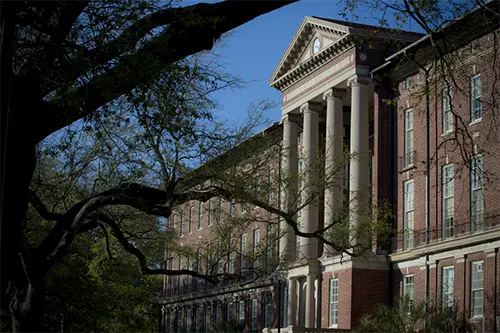

When I arrived at Tulane over 3 years ago, I was excited, like most freshmen, for my new independence, to live in a new part of the country, and of course, to experience Mardi Gras. Little did I know that at Tulane, I would fall in love not only with the city of New Orleans but also with the study of international relations, that I would find amazing mentors, that I would develop meaningful expertise on important world issues through my coursework and thesis research, and that I would even have the amazing opportunity to share my education and insights with the greater New Orleans community.
Last year, as a junior in the School of Liberal Arts, I was invited to speak at a Jewish lawyers’ event and at a local synagogue about the experiences of Jewish students on campus following October 7, 2023. It was incredibly exciting (and to be honest, intimidating), but helped me develop confidence in public speaking. My most exciting speaking opportunity, however, took place last weekend when I was invited to speak as part of a three-person panel for Limmud New Orleans, a festival of Jewish learning at the Uptown Jewish Community Center (JCC). The event featured a host of Jewish educators, leaders, professors, and religious leaders delivering lectures on different topics related to Jewish current events and related topics. During my panel, I spoke alongside distinguished Tulane University professor Michael Wallace, a retired military intelligence officer, as well as Sam Melamed, an Iranian-American Jew with a strong understanding of the experience of a Persian living in the U.S. We discussed recent events in Iran, what led to them, and what they mean for the Middle East going forward.
This is a topic that I care deeply about, as I am completing my Newcomb Tulane College honors thesis on proxy-warfare, using Iran as a case study. I was invited to speak because of the incredible support I have received from Tulane faculty, and particularly Professor Brian Horowitz, who recommended me to David Singer, the CEO of Limmud, as someone who has been studying Iran-related issues throughout my undergraduate education.
The panel was moderated by Singer and featured an animated conversation in which we addressed the geopolitical relevance of the current conflict, as well as its historical context. I was asked about how Iran’s proxy network and its relative decline have played a role in the lead-up to the current military conflict. I responded by speaking about one key observation I have made in my research. The October 7, 2023, Hamas attacks and subsequent Hezbollah attacks, while intended to reshape the Middle East in a way favorable to the “Axis of Resistance" and Iranian interests, actually succeeded in causing the deterioration of Iran’s armed proxy network.
I also talked about how the Hamas and Hezbollah attacks against Israel created a shift in both the Israeli and American approaches toward counterterrorism. Subsequent military operations have left Hamas and Hezbollah crippled and struggling to retaliate on behalf of the Iranian regime as they have in the past. These conditions allowed for the U.S. and Israel to confront Iran directly, undeterred by the regime’s proxy forces.
Not only was I able to share my knowledge about the history and state of Iranian military strategy, but I was also able to learn from the other panel speakers and audience. Professor Wallace’s knowledge and passion for global security and counterterrorism shone through. He provided deep insights into the conflict, as well as estimations of potential outcomes and ramifications for the Middle East. Since my background on global conflicts is purely academic, hearing from a retired military officer was enlightening as to the human costs of war.
In addition to Professor Wallace’s perspective, I was able to better understand the Iranian-American experience through the words of Melamed. He spoke of the surreal nature of a status quo life in the U.S. while many of his countrymen are dying in Iran from crackdowns on protests. He described a feeling of collective urgency and aspiration for democracy among the Iranian diaspora, and likely by many Iranians still in Iran. Melamed paints a story of a people longing for normality, safety, and a democratic future for their children.
My experience at Limmud is just one of many examples of how Tulane has fostered engagement with the New Orleans community. Tulane has supported my internship with the Jefferson Parish District Attorney’s office, my desire to learn, and my interest in the Middle East. All of these experiences have not only allowed me to deepen my understanding of world affairs but have enabled me to meet amazing people and given me new perspectives and confidence that I hope to carry forward as I graduate from college and pursue a career in law and policy.