
The Tulane chapter of Phi Alpha Theta, an elite national honors society for history students, recently traveled to Lafayette, LA, to attend a conference in partnership with the Louisiana Historic Association. The convening brought together students, professors, and public history professionals from around the region to present research on a wide range of topics, ranging from European history to local stories of Louisiana.
As secretary and one of the cofounders for Tulane’s chapter of Phi Alpha Theta, I presented my research on Romani prosecution during the Spanish Inquisition. Romani is a term to describe an ethnic group who migrated from India to Europe during the 12th century. While migrating across Europe, Romani would adopt the local culture and blend it with their own culture and religion. During the Inquisition, the Spanish government wished to create a unified Catholic religion. Because Romani did not adhere to Spain’s strict guidelines, the Spanish government labeled Roma as atheists, idolaters, and witches. Throughout the paper, I debunked these myths and accusations, proving that Romani were, in fact, Catholics. I focused my evidence using primary resources, such as Inquisitional court transcripts, hagiographies, and Romani voices to conduct my research.
Sophia Quintana, a freshman and one of the newest members of Tulane’s Phi Alpha Theta, was excited to attend her first academic conference and present her paper “Jamaica’s Blue Mountains: The Maroons of Queen Nanny and Cudjoe.” Sophia presented on the Maroon communities of Jamaica, because “it’s important to understand the broader scope of African rebellion,” she said. The complexities of Caribbean history and thinking deeply about how to hear the perspective of enslaved people, she explained, are vital when analyzing historical documents primarily written by white Europeans.
Zoe Sibert, a senior history major, presented her year-long research project on New Orleans’ sex education legislation during the 1970s, which will be published in the Tulane digital library. She consulted documents at the Newcomb Institute archives, the Orleans Parish school records at the University of New Orleans, and oral histories to create her digital independent study. Zoe’s presentation highlighted the cooperative efforts from members of the New Orleans community to document local history. The personal stories and testimonies by New Orleanians demonstrate how history is a collaborative effort, especially local histories.
Lauren Alexander, a junior English major, presented her paper, “The Radical Life of Johnnie Lacy: Black Feminist Disability Rights Advocate.” She shared that she wanted to do a biographical analysis, which is innately historical. Rather than focusing on historiography, she viewed her research paper through the lens of storytelling, a skill she said she uses often for creative writing and poetry in her major.
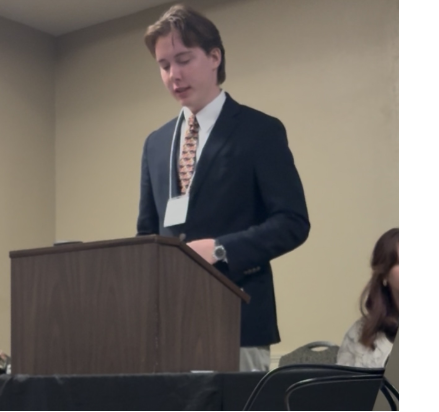
Some presentations hit closer to home — Tulane’s anyway. Adrian Serieyssol, a Junior Tulane history major, offered his research on a New Orleans folk hero. “Allan Jaffe, The Jazz Man, How New Orleans Jazz Was Saved” outlined Jaffe’s migration from Pottsville, Pennsylvania, by way of a honeymoon in Mexico to land in New Orleans with his new bride. The story of Preservation Hall and its jazz band is widely known in the local music community, but Serieyssol documented it for the archives, adding new biographical details from interviews with musicians and family members.
The conference awarded Tulane’s students’ work significant acclaim. Senior Camille Lowery’s paper, “Places of Separation as Spatial Archive in the WPA Slave Narratives of the U.S. South,” won the Kimberly S. Hanger Prize for the Best Undergraduate-Level Paper. Caroline Mehno’s presentation, “Post-War Urban Transformation through the Poetry of Allen Ginsberg,” received one of two Honorable Mentions by the Hanger Prize Committee.
Between presentations, I asked Professor Rosanne Adderley, who is celebrating her 30th year with Tulane, about her relationship with Phi Alpha Theta. She shared that during the 2000s, Tulane’s Chapter of Phi Alpha Theta sponsored several local events. By the 2010s, the chapter had lost energy and declined. Over the last three years, students have shown increased levels of engagement with the History Department and Phi Alpha Theta. 2025 marked the first time Tulane’s chapter of Phi Alpha Theta attended a history conference. Although initially a small group, Phi Alpha Theta’s involvement skyrocketed for this year’s regional conference. In total, 12 Tulanians attended this year’s conference, a sixfold increase from last year.
Senior Ruby Loeffler, Tulane’s Phi Alpha Theta Advisor and History Professor Karissa Haugeberg, and Professor Adderley all put in tremendous effort to make this opportunity a reality.