

Originally published in the 2026 issue of the School of Liberal Arts Magazine.
Nobody arrives at college knowing where they’ll belong.
You choose a dorm. You choose classes. Sometimes you even choose a major before you’ve learned enough to know whether it’s the right one.
Belonging usually comes later. It happens in places you never expected to matter.
For generations of Tulane students, one of those places has been Newcomb Hall.
Some first found it because of a language class. Others because a professor suggested office hours. Some wandered in for philosophy or sociology and kept coming back for reasons that had little to do with the syllabus. Years later, many would remember the hallway more clearly than the assignment. The conversation more vividly than the lecture.
The places we remember are rarely the ones we planned to remember.
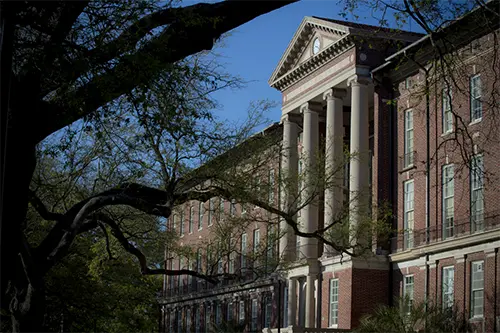
When Newcomb Hall opened in 1918, it was the academic and administrative heart of H. Sophie Newcomb Memorial College, one of the nation’s pioneering colleges for women. Across campus, students in Tulane’s College of Arts & Sciences built traditions of their own. They belonged to different schools, but increasingly shared the same classes, the same questions, and the same belief that a liberal arts education begins with curiosity.
Long before anyone gave it a new name, a community had already begun to form.
Newcomb Hall witnessed that change.
It remained rooted in the history of Newcomb College while gradually becoming one of the places where Tulane’s broader liberal arts community came together. By the time Tulane University School of Liberal Arts was created in 2006, the intellectual community it represented had already been taking shape for decades.
For the past several years, Newcomb Hall has stood quietly behind fencing and scaffolding while its next chapter was written from the inside out.
Some of the changes are easy to see. New technology. Modern infrastructure. Spaces designed to serve another century.
In selecting New Orleans architects from the New Orleans firm Waggonner & Ball to renovate James Gamble Rogers’ original design, Dean Brian T. Edwards sought to bring back the light to a building marked by large windows. “Over the decades, as the building was carved up to make space for more offices and departments, the light that was central to Rogers’ design had been blocked out,” says Edwards.
David Waggoner, whose firm led the renovation of Dinwiddie Hall across campus in 2010, saw the possibility. New light monitors emerging from the building’s roof, constructed of carefully treated glass, draw daylight deep into the fourth floor, restoring openness to spaces that had gradually turned inward over decades of renovation. Reopened sightlines and welcoming common areas invite people to pause instead of simply passing through.
The first floor once again welcomes the wider university, bringing together the Dean’s Office, the Tulane Global Humanities Center, the office of the Strategy, Leadership and Analytics Minor (SLAM), classrooms and gathering spaces designed for lectures, talks, events, and conversations that refuse to stay inside a single discipline. Upstairs in the Alison Brod Media and Communication Wing, students will learn about the history and analysis of a range of media and have dynamic spaces to produce and edit films, podcasts, and digital stories in editing suites, recording studios, sound isolation booths and collaborative production labs built for the way people communicate today. Two screening rooms, one with fixed seating, light lock doors, and Dolby sound, and another designed for showing work in progress, will be places where the community will gather.
The renewal extends beyond the spaces students will see every day. More sustainable materials, energy-efficient systems, and modern infrastructure will reduce the building’s environmental footprint while preserving one of Tulane’s architectural landmarks for generations to come. Rather than replacing Newcomb Hall, the university has chosen to renew it, extending the life of a historic building while preparing it for the future.
Throughout the building, named spaces recognize alumni and friends whose generosity made this renewal possible. Their gifts do more than restore a building. They invest in the people who will fill it.
Buildings like Newcomb Hall have never been remarkable because of the limestone or the architecture. They matter because generation after generation leaves something behind for the people who arrive next.
SLAM Center
“The space combines our dynamic SLAM program with a space for research into the future of work.”
— Vicki Mayer, Senior Advisor to the Dean, Professor of Communication
The Argenti Family Office
“I remember the bustling energy of students throughout Newcomb Hall, and my international relations classes in Newcomb’s majestic classical spaces.”
— John Argenti (A&S ’85)
Tulane Global Humanities Center
“The new Tulane Global Humanities space will play a crucial role in facilitating the kind of collaborative critical inquiry that is the hallmark of the humanities.”
— Edwige Tamalet Talbayev, Tulane Global Humanities Center Faculty Advisory Board Member and Associate Professor, French & Italian
Davis Room
“This will be the premier location to hold lectures, symposia, and gatherings. This event space is for the entire School of Liberal Arts community.”
— Brian T. Edwards, Dean of the School of Liberal Arts
Wolfberg Welcome Lounge
“Having experienced Tulane as an alumnus and as a Tulane parent, supporting this renovation was important because we wanted to help create a space that reflects the excellence of Tulane today and gives current and future generations of students a place they can be proud of.”
— Robert (A&S ’92) and Lynne Wolfberg
Senator John Hardy “Johnny” Isakson Conference Room
“I really liked the idea of sponsoring the conference room because I wanted to dedicate the space to my father who was great at bringing people together to solve problems, discuss ideas, or just get together for a good conversation. Seeing the renovation begin to bring the space to life is very exciting and I can’t wait to see the final product.
One of my most distinct memories of Newcomb Hall was the odd elevator configuration which I am so happy to see being addressed. I walked up a lot of stairs in my day just to avoid the hassle….”
— John Isakson (A&S ’92)
Digital Media Practices Lab & Finishing Room
“I’m excited about the fourth-floor studios. In the music and creative industries, you’re expected to create and publish your own content, and letting students record interviews and produce real projects in professionally equipped rooms is exactly the kind of hands-on learning these courses are built for.”
— Taku Hirano, Professor of Practice, Newcomb Department of Music and SLAM
Miller Family Dean’s Office
“Tulane is where my journey began, and giving back is a meaningful way to honor that experience. Supporting the renovation of Newcomb Hall allows me to celebrate what Tulane has meant to me while helping ensure this special place continues to serve and inspire generations of students to come.”
— Barry (A&S ’91) and Tomm Miller
Digital Editing Lab
“After spending hundreds of hours on post-production, I am excited for the new energy the digital editing lab brings, with more space for creation and collaboration.”
— Keira Ruibal (SLA ’27)
Screening Room
“From providing students and visiting artists with a professional screening environment to share their work to opening up a new resource for local filmmakers to host work-in-progress screenings, these spaces hold immense potential to spark collaboration and prepare students for working in a real-world media environment.”
— Jolene Pinder, Program Director, Digital Media Practices, and Professor of Practice, Communication and Digital Media Practices