
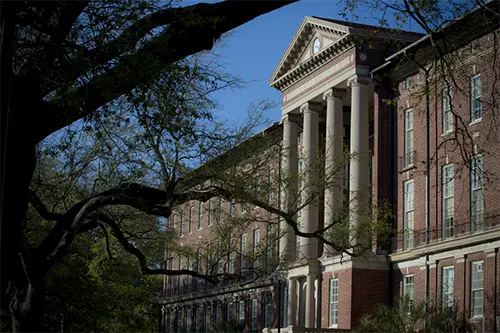
Meet the speakers and workshop leaders participating in the 21st Annual Tulane Maya Symposium & Workshop.
 Luke Auld-Thomas
Dr. Luke Auld-Thomas is an Assistant Professor of Anthropology at Northern Arizona University. He received his PhD from Tulane University in 2025. His dissertation research, undertaken with the Proyecto Regional Arqueológico La Corona, focused on the site of El Achiotal, a modest and unusual Protoclassic royal capital 20 km east of La Corona. He is an expert in archaeological remote sensing, and his research addresses questions about early urbanism, social-ecological systems, and the transformation of complex polities and urbanized landscapes under environmental stress.
 Tomás Barrientos Q.
Dr. Tomás Barrientos Q. has conducted archaeological research throughout Guatemala for more than 30 years and currently serves as the Director of the Department of Archaeology at Universidad del Valle de Guatemala. He is also Co-Director of the La Corona Regional Archaeological Project. He previously directed the Cancuén Archaeological Project, a pioneering effort in integrating Indigenous community development into archaeological research and sustainable tourism.
His areas of specialization include the archaeology of the Lowlands, Highlands, and Pacific Coast, with a particular focus on spatial analysis of architecture, ancient geopolitics, cultural heritage management and administration, public archaeology, digital archive management, identity studies, sustainable cultural tourism, pre-Columbian foodways, and cultural astronomy.
He holds a doctorate in anthropology from Vanderbilt University and has taught courses in archaeology, anthropology, and tourism. He has participated in more than 350 conferences in 13 countries and is the author of or contributor to more than 200 publications, including books, academic journal articles, technical reports, and digital media. He has also made more than 50 appearances in documentary films and radio and television interviews.
 Clarissa Cagnato
Dr. Clarissa Cagnato uses macro- and microbotanical remains to reconstruct ancient diets and rituals. She obtained a master’s degree from Yale University, followed by a doctorate from Washington University in St. Louis, where she carried out fieldwork at La Corona and El Peru-Waka’, supported by the National Science Foundation. Since relocating to France, she has engaged in diverse projects, spanning from the Paleolithic in Central Asia to Neolithic and Medieval populations in France and Iron Age societies in Central Africa, and serves as the project paleoethnobotanist for the Project Plaza of the Columns Complex at Teotihuacan. Most recently, a Marie Skłodowska-Curie postdoctoral fellowship at the University of Ca’ Foscari in Venice, Italy, enabled her to develop non-destructive methodologies for the study of ancient carbonized remains and, in turn, better reconstruct culinary traditions. She currently serves as an editor for the journal Scientific Reports.
 Marcello A. Canuto
Dr. Marcello A. Canuto is currently Director of the Middle American Research Institute and Professor of Anthropology at Tulane University. He received his BA from Harvard University in 1991 and his PhD from the University of Pennsylvania in 2002. Before coming to Tulane in 2009, he was an Assistant Professor at Yale University.
He has undertaken archaeological excavations in the Maya region, South America, India, North Africa, and the Northeast US. His primary research interest in the Maya area has been the integrative mechanisms the ancient Maya used to build and maintain a socio-politically complex society throughout the Preclassic and Classic periods. More broadly, his interests include household and community dynamics, the development of socio-political complexity in ancient societies, the definition of identity through material culture, and the modern social contexts of archaeology in Mesoamerica. His prior research in Honduras investigated the nature of ethnic diversity at Copan. He now co-directs a project in the understudied Northwest Peten, Guatemala, where he investigates the construction of social categories and the mechanisms by which complex socio-political organizations developed and were maintained.
Among many publications are the edited volumes The Regimes of the Ancient Maya (in preparation with Cambridge, 2019), Understanding Early Classic Copan: New Research and New Themes (University of Pennsylvania, 2004), and The Archaeology of Communities: A New World Perspective (Routledge, 2000). He also serves on the U.S. Board of the Universidad del Valle Guatemala.
 Rodrigo Guzman Piedrasanta
Dr. Rodrigo Guzman Piedrasanta is an archaeologist from Quetzaltenango, Guatemala, and currently serves as the Global Digital Heritage Initiative Postdoctoral Fellow at the Middle American Research Institute at Tulane University. Previously, he was a postdoctoral scholar in the Department of Anthropology at the University of Central Florida (UCF) from 2022 to 2025. He earned his PhD from UCF in 2022 as a member of the inaugural cohort of the Integrative Anthropological Sciences program and the first international student. He also has a Master of Arts degree in Anthropology from UCF (2017) and an undergraduate degree in Archaeology from Universidad del Valle de Guatemala (2010). Rodrigo Guzman specializes in Maya Archaeology, Landscape Archaeology, and the application of Geographic Information Systems (GIS) to Archaeology and Cultural Heritage. His field expertise includes mapping in the Maya Lowlands at Holmul, La Corona, Holtun, El Encanto, and El Mirador; archaeological survey in the Maya Highlands at El Soch; and research in the Maya Pacific at Rio Seco. He has also participated as a GIS specialist in remote research in the US Virgin Islands. He also serves as a GIS advisor for the UCF-El Mirador Archaeological Project. He is a registered professional archaeologist in the United States and is affiliated with the Register of Professional Humanists of Guatemala.
 Rachel A. Horowitz
Dr. Rachel A. Horowitz is an Associate Professor in the Department of Anthropology at Washington State University. She holds an MA and PhD from Tulane University. Dr. Horowitz is an anthropological archaeologist whose research examines past Maya economies through the lens of lithics, or stone tool technology. She combines detailed analysis of lithic production activities with experimental archaeology and raw material sourcing. Her current research foci are in Belize and Guatemala, and her research has been funded by the National Science Foundation, National Geographic, and the Wenner-Gren Foundation. She is the co-editor of Lithic Technologies in Sedentary Societies and Ancient Maya Embedded Economies and has published in journals including Latin American Antiquity, Ancient Mesoamerica, and Antiquity.
 Mary Kate Kelly
Dr. Mary Kate Kelly graduated with a PhD in Linguistic Anthropology from Tulane University in 2022. She is an Assistant Professor in the Department of General Education at Mount Royal University in Calgary. Her research tracks historical sociolinguistic narratives of the ancient Maya, examining linguistic variation in hieroglyphic inscriptions to gain insight into the ancient distribution of distinct yet related Mayan linguistic groups. She is also the Project Epigrapher for the Proyecto Arqueológico Waka’ and the Proyecto Arqueológico Sak B’alam, where she works with archaeologically excavated inscriptions, particularly in digitally recording them through photogrammetry, illustration, and 3D printing. Her interests include social and political histories and how they are expressed through language and writing, as well as decolonizing our work through collaboration with heritage communities. Her work highlights how language serves to unite, divide, conquer, revitalize, include, and exclude – all factors in everyday communication whether we do so consciously or not.
 Jordan Kobylt
Jordan Kobylt is a Tulane Anthropology PhD student focused on Maya archaeology. His research interests include ancient urbanism, settlement patterns, households, and sociopolitics. He is a member of the Proyecto Arqueológico Bajo el Laberinto (PABEL), which conducts fieldwork at the ancient Maya site of Calakmul, located in Mexico’s state of Campeche. His dissertation research focuses on processes of urban densification at Calakmul. Jordan has also participated in fieldwork at other Maya sites in Mexico, Guatemala, and Belize. Before coming to Tulane, he received his BA in Anthropology from UC Berkeley and worked as an archaeological field technician in California and Oregon.
 Maxime Lamoureux-St-Hilaire
Dr. Maxime Lamoureux-St-Hilaire is an Associate Professor of Anthropology at Mount Royal University, Calgary, Canada. He received his BSc from Université de Montréal (2008), his MA from Trent University (2011), and his PhD from Tulane University (2018). He was fortunate to be tasked with excavating the regal palace of Sak Nikte’ for his doctoral research, unearthing many of its impressive buildings and hieroglyphic monuments.
Max is currently dedicating himself to slowly building a community-engaged project in Guatemala and to writing about ancient politics. Among his publications are the recent book A Critical Archaeology of Politics (Cambridge Element), the edited volumes Regimes of the Ancient Maya (with Marcello A. Canuto, Oxford University Press) and Detachment from Place: Beyond an Archaeology of Settlement Abandonment (with Scott Macrae, University Press of Colorado); articles in Journal of Anthropological Archaeology, Geoarchaeology, Latin American Antiquity, Ancient Mesoamerica, and the Canadian Journal of Archaeology; along with chapters in several edited volumes. As Editor-in-Chief of the open-access and bilingual journal The Mayanist, Max aims to elevate diverse voices in academic literature centered on the Maya world.
 Damien B. Marken
Dr. Damien Marken is an Associate Professor of Anthropology at Commonwealth University of Pennsylvania-Bloomsburg, where he teaches anthropology and archaeology. A National Geographic Society Explorer and Explorers Club Fellow, he is Co-Director of the Waka’ Archaeological Project in northwestern Petén, Guatemala. His research explores the interrelated processes of urbanization and state organization in the Maya Lowlands through the study of settlement and land-use patterns and household archaeology. He is the editor of Palenque: Recent Investigations at the Classic Maya Center (Altamira, 2007), and co-editor of Classic Maya Polities of the Southern Lowlands (with James Fitzsimmons, University Press of Colorado, 2015), Building an Archaeology of Lowland Maya Urbanism: Flexibility and Planning in the American Tropics (with M. Charlotte Arnauld, University Press of Colorado, 2023), and El Perú-Waka’: New Archaeological Perspectives on the Kingdom of the Centipede (with Keith Eppich and David Freidel, University of Florida Press, 2024).
 Caroline (Carrie) Parris
Dr. Caroline (Carrie) Parris is Research Collections Director at the University of Iowa Office of the State Archaeologist and an Adjunct Assistant Professor in the University of Iowa's Department of Anthropology. Carrie holds a B.A. in Anthropology from Sewanee: The University of the South and an M.A. and a Ph.D. in Anthropology from Tulane University.
As a member of the La Corona Archaeological Project from 2009-2021, Carrie fulfilled a variety of roles including lab assistant, excavation supervisor, researcher, and project ceramicist. Her dissertation research used ceramic analysis methods to understand the Late Classic period residents of La Corona’s commensal practices (how they ate together).
While a graduate student at Tulane University, Carrie managed the collections of Middle American Research Institute. In her current role as Research Collections Director at the University of Iowa Office of the State Archaeologist, Carrie manages the State Archaeological Repository, supervises the archaeology lab, assists researchers, hosts Museum Studies interns, and collaborates on archaeological collection and data management initiatives. Her favorite type of sherd is a grit tempered Encanto Striated body sherd: locally made, textured, well-fired, and non-diagnostic but essential to the everyday life of the Late Classic period Maya.
 Jocelyne Ponce
Dr. Jocelyne Ponce is an anthropological archaeologist who earned her PhD from Tulane University. She holds a Licenciatura and BA from Universidad del Valle de Guatemala and is currently a Research Affiliate at the Middle American Research Institute. Her research interests include human-environment interactions, urbanism, social inequality, gender, intersectionality, and community-engaged participatory research, with a particular focus on Maya household and community dynamics. She has participated in archaeological projects in Guatemala, Mexico, Ecuador, and Peru. Dr. Ponce’s research has been supported by several organizations, including the National Science Foundation, Fulbright-Hays, the Lambda Alpha National Anthropology Honor Society, and the American Association of University Women.
 David Stuart
Dr. David Stuart’s research focuses on the archaeology, art, and epigraphy of Mesoamerica, especially ancient Maya civilization. Since 2004, he has been the Schele Professor of Mesoamerican Art and Writing in the Department of Art and Art History at the University of Texas at Austin. Stuart received his PhD in Anthropology from Vanderbilt University in 1995. His early work in Maya decipherment led to a MacArthur Fellowship from 1984–89. In 2011, he was awarded a fellowship by the John Simon Guggenheim Foundation. He has written several books, most recently The Four Heavens: A New History of the Ancient Maya (Princeton University Press, 2026).
 Marc Zender
Dr. Marc Zender received his PhD from the Department of Anthropology & Archaeology of the University of Calgary in 2004. He has taught at the University of Calgary (2002–2004) and Harvard University (2005–2011), and is now an Associate Professor of Anthropology and Director of the Interdisciplinary Linguistics Program at Tulane University (2011–present), where he teaches Mesoamerican indigenous languages and writing systems. His research interests include anthropological and historical linguistics, comparative writing systems, and decipherment.