27" x 50"
Ink and brush on paper
2021
Motivated by the anxiety around shopping and public spaces during the Covid pandemic, this drawing reimagines the excess and expanse of Andreas Gursky’s “99 Cent” as the inner landscape of a body.


Anthony Baab studied Painting and Printmaking at the Kansas City Art Institute (’04) before obtaining an MFA in Interdisciplinary Art from Cornell University (’09). Representing a wide range of media, his recent work consists of drawings, sculptures, and large-scale models that explore notions of self-reflexivity. His work has been exhibited at Grand Arts (Kansas City), Dan Graham (Los Angeles), The Mattress Factory (Pittsburgh), and Three Walls (Chicago) and has been included in several permanent collections including: The Nelson Atkins Museum of Art, The Nerman Museum of Contemporary Art, The Marianna Kistler Beach Museum, and The Microsoft Collection. Recently, Baab was a 2014–15 Fine Arts Work Center Provincetown Fellow and resident at the Skowhegan School of Painting and Drawing (’15). His work is represented by Haw Contemporary in Kansas City.
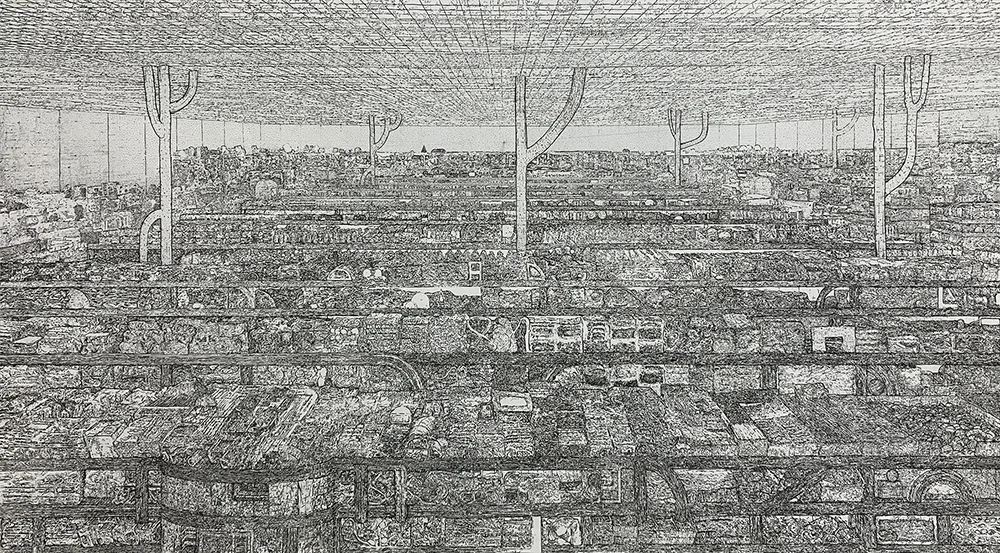 Stores
27" x 50"
Ink and brush on paper
2021
Motivated by the anxiety around shopping and public spaces during the Covid pandemic, this drawing reimagines the excess and expanse of Andreas Gursky’s “99 Cent” as the inner landscape of a body.
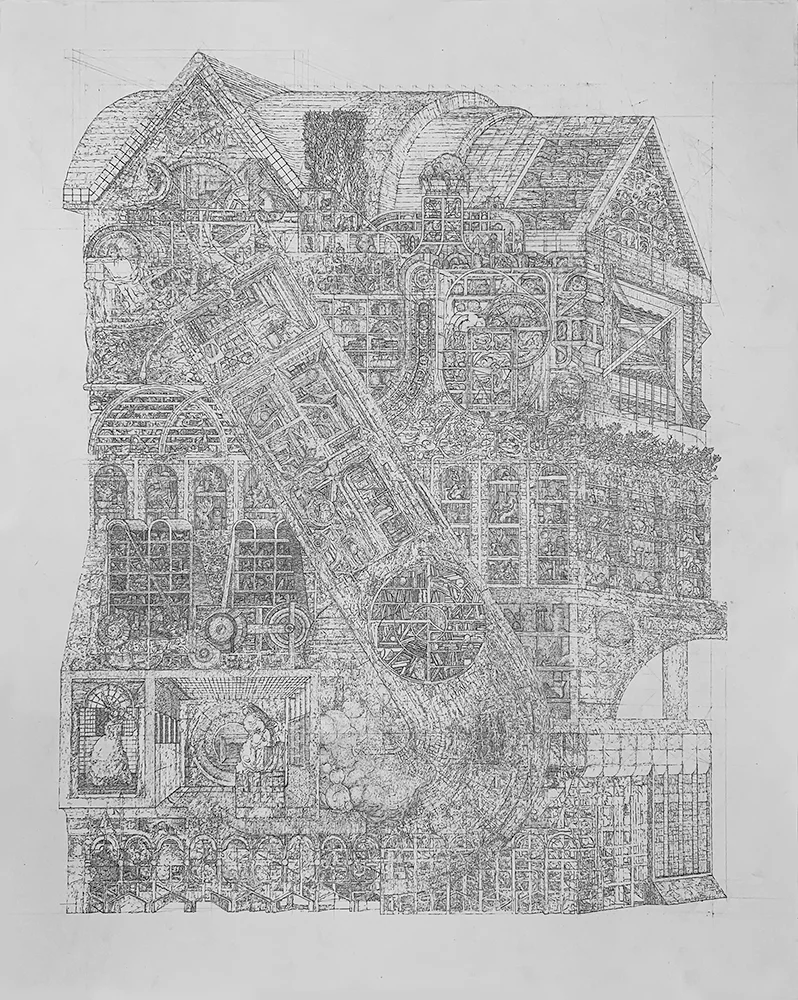 House
House
24" x 19"
Ink and pencil on paper
2020
Beginning as an iterative sequence of pencil sketches and overlapping grids, the work takes shape through repeated drawing, erasure, and the accidental confluence of layers. Final forms are subsequently mapped out through selective ink tracing.
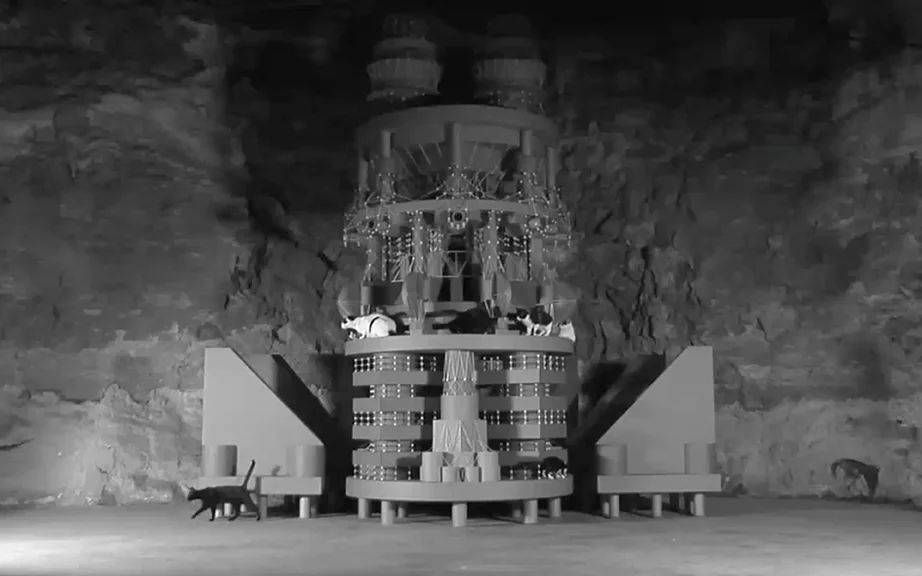 Strenuous Nonbeing
“Strenuous Nonbeing”
Live video loop
2013
Strenuous Nonbeing includes a 14ft architectural model that was placed in an undisclosed location with seven cats. This event was televised live during the opening of A Strenuous Nonbeing at Grand Arts. Watch the full video.
 Chard
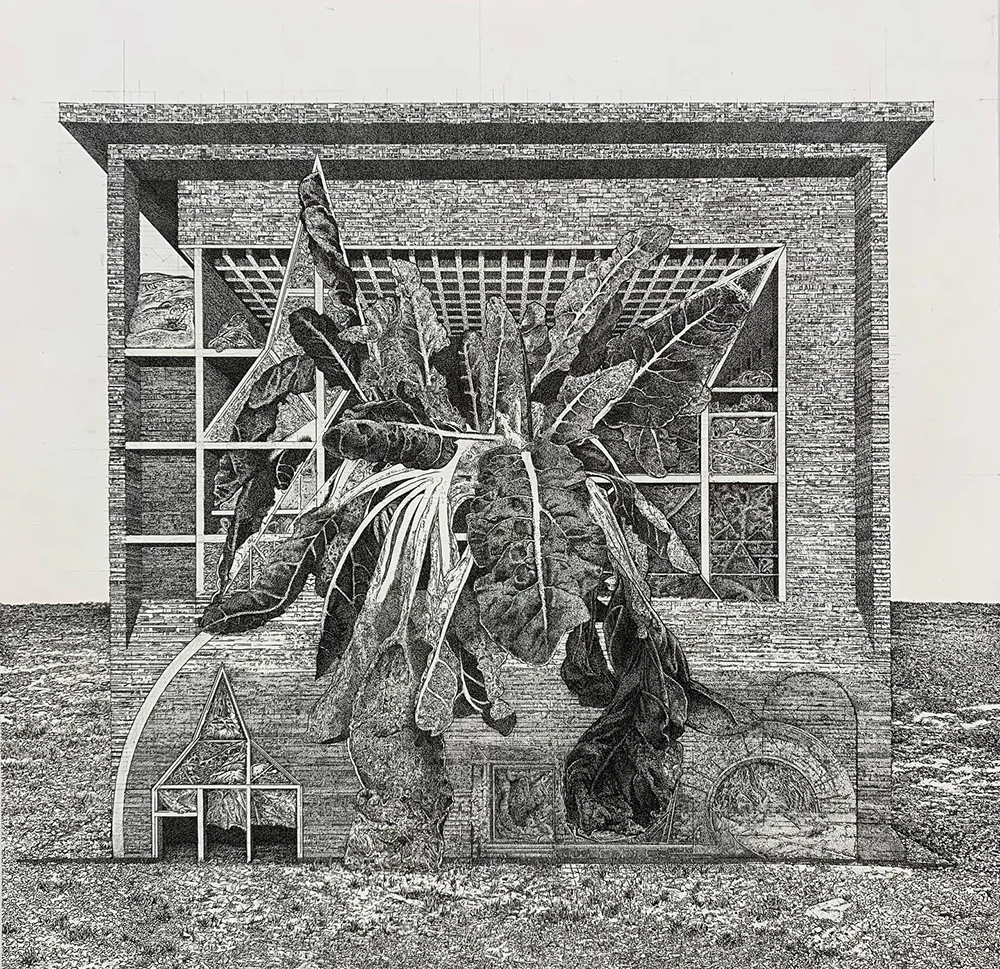
Chard
Ink on paper
21" x 21"
2023
Beginning as an iterative sequence of pencil sketches and overlapping grids, the work takes shape through repeated drawing, erasure, and the accidental confluence of layers. Final forms are subsequently mapped out through selective ink tracing.
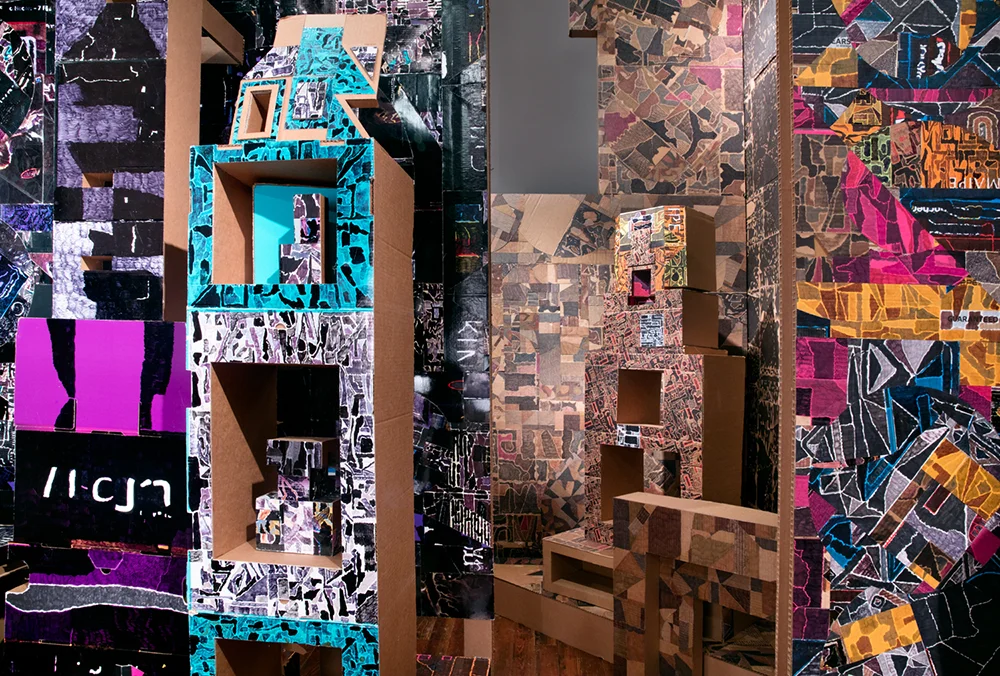 Cover the Earth I
Found boxes, cardboard displays, cardboard, markers, glue
Dimensions variable
2014–2017
As an itinerant, traveling project, Cover the Earth is an ever expanding and mutating form that undergoes a complete transformation from one location to the next. Between each location, the sculptures are broken down, repaired and re-purposed, much like a collage.Adding as many brands and objects as possible, the meaning and function of these products dissolve over and over again, allowing for new meanings and associations to form.
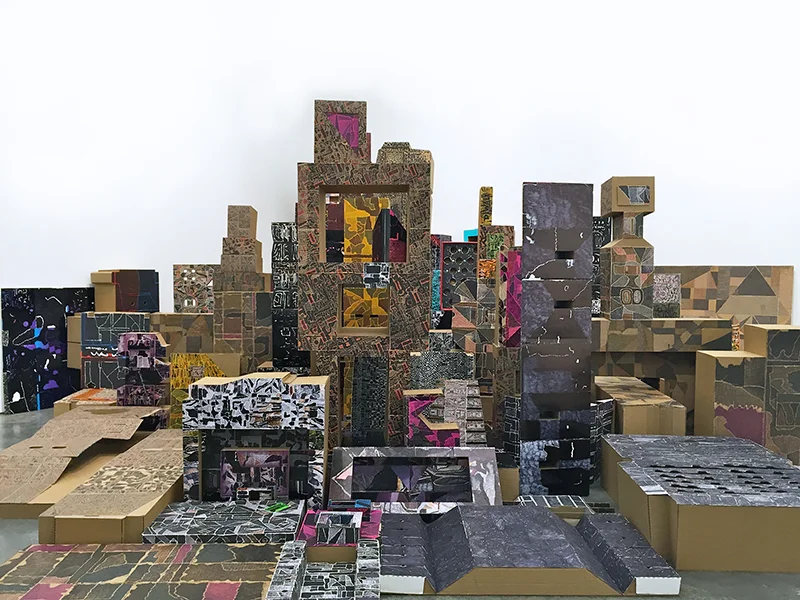 Cover the Earth II
Found boxes, cardboard displays, cardboard, markers, glue
Dimensions variable
2014–2017
As an itinerant, traveling project, Cover the Earth is an ever expanding and mutating form that undergoes a complete transformation from one location to the next. Between each location, the sculptures are broken down, repaired and re-purposed, much like a collage.Adding as many brands and objects as possible, the meaning and function of these products dissolve over and over again, allowing for new meanings and associations to form.
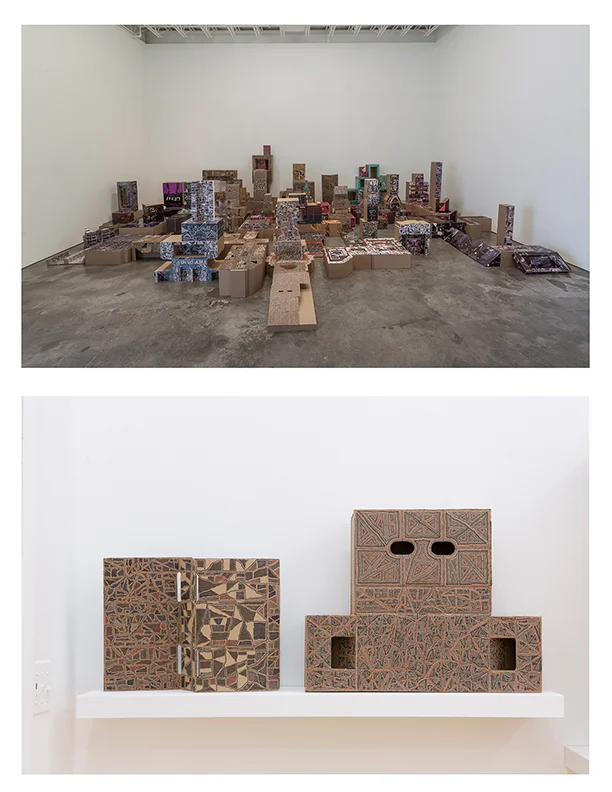 Cover the Earth III and IV
Found boxes, cardboard displays, cardboard, markers, glue
Dimensions variable
2014–2017
As an itinerant, traveling project, Cover the Earth is an ever expanding and mutating form that undergoes a complete transformation from one location to the next. Between each location, the sculptures are broken down, repaired and re-purposed, much like a collage.Adding as many brands and objects as possible, the meaning and function of these products dissolve over and over again, allowing for new meanings and associations to form.
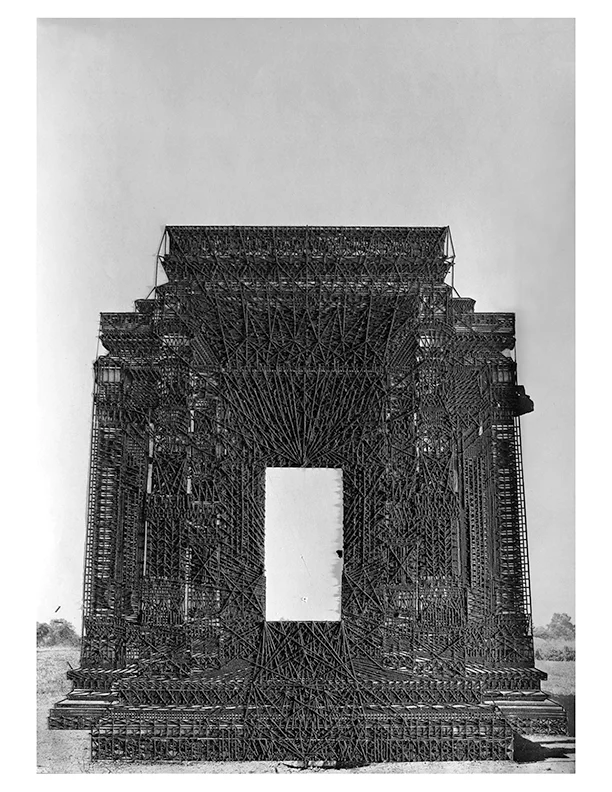 Temple
Tape and found picture
12" x 9"
2011
Temple overlays an appropriated picture of a Hindu temple with dense networks of graphic tape—a drafting material largely superseded by digital design tools. Successive strata of this adhesive line obscure, alter, and reconfigure the architectural subject.
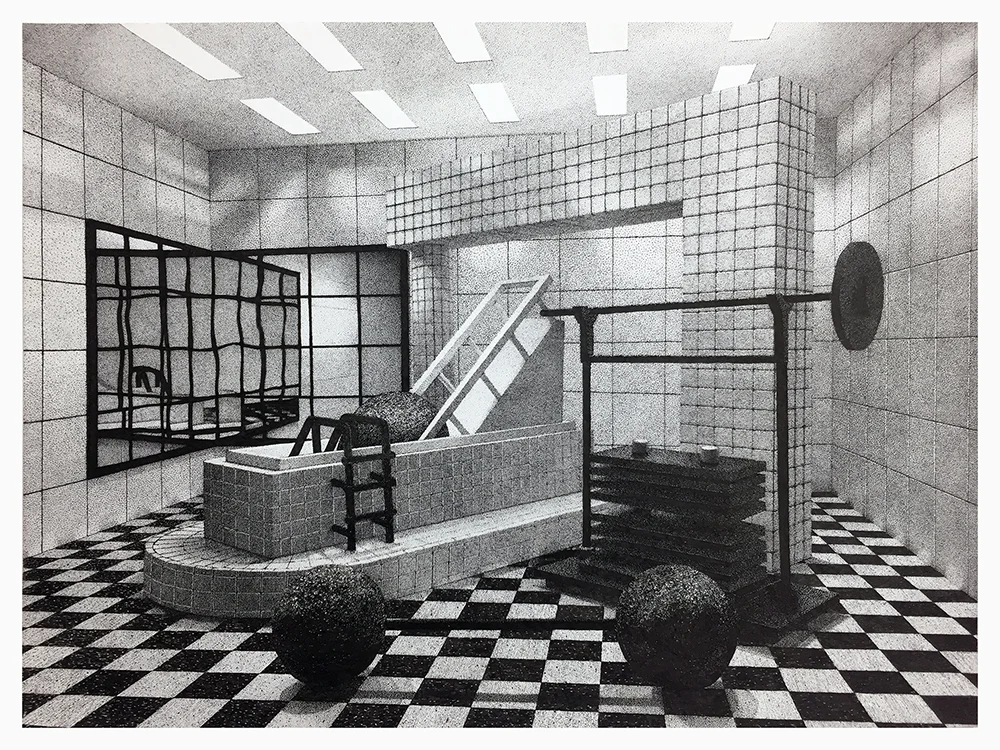 Permanent Tarnation
Ink on paper
12" x 16"
2019
Drawn from a constructed model, Permanent Tarnation comprises a series of comic-like stipple drawings that channel the earnest, whimsical optimism of 1970s and 80s educational learning materials to frame absurd, banal scenarios. The work maps out an imaginary fitness apparatus built around a boulder-scaled sphere, which must be methodically hoisted up a steep, miniaturized incline in an endless Sisyphean loop.
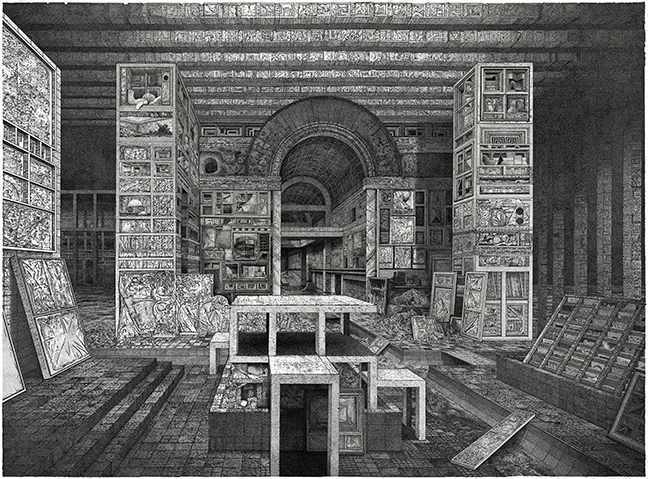 Underground Storage
Ink on Paper
33'' x 44''
2023–25
Underground Storage draws on decommissioned limestone quarries toured during the 2013 site search for Strenuous Nonbeing. These subterranean vaults—customarily used to archive vintage vehicles, government records, and cultural artifacts—inform a protected environment dedicated to permanent, covert, and provisional storage. Within this space, once-precious items are dismantled or repurposed into structural platforms and patching material. Echoing Giovanni Panini’s cathedral-like vedute interiors densely layered with art, the work establishes a deeply interiorized setting that simulates a false exterior, where wall and ceiling compositions offer pictures in place of expansive views.
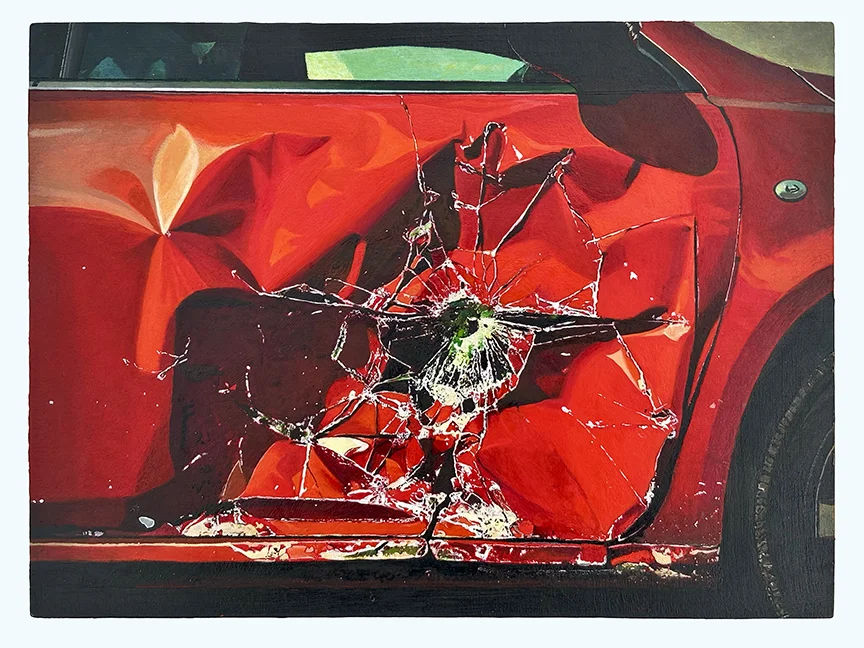 Red Car
Acrylic on panel
9" x 12"
2026
Red Car originates from an ongoing fascination with the battered automobiles of New Orleans. In a city shaped by climate, infrastructure strain, and economic hardship, vehicles function as more than utilitarian tools or status symbols; their accumulated dents, weather damage, and improvised repairs read as a vernacular badge of endurance. Hesitant to photograph cars directly, the process relied on translating observed street details into prompts for artificial intelligence. A pivotal technical discovery emerged when the software failed to render a damaged door, confusing sheet metal with bullet-punctured glass. This glitch redirected the focus from physical urban decay to the uncanny, glitchy materiality of contemporary AI imagery. Serving as a first foray into realistic painting, Red Car marks a personal milestone in questioning notions of resilience, beauty, and the present.
 Untitled
Dye infused aluminum
Dimensions variable
2013
A photograph was initially taken of a folded sheet of copy paper and then printed on the same sheet. The resulting picture was then folded, photographed, and printed again, many times. The final image was then printed on folded aluminum.