
Exploring the Depths of Thought: Professor Daniel Burnston at the Helm of Thought-Provoking Cognitive Studies Research
In the realm of cutting-edge interdisciplinary research, Tulane Liberal Arts Associate Professor of Philosophy and Director of Cognitive Studies Daniel Burnston is part of a collaborative team breaking new ground in studying cognition. Burnston’s group received $165,000 in funding from the Research Corporation for Science Advancement’s (RCSA) Scialog: Molecular Basis of Cognition initiative to spearhead a project titled Mapping Inner Worlds: Representational Spaces and Mental Life.
Collaborating with Psychology Professor Wilma Bainbridge from the University of Chicago and Psychology Professor Bob Wilson from the University of Arizona, the team will explore the organization of categories and knowledge in the mind and brain. It is frequently hypothesized that mental categories for objects are organized into a “space,” with similar categories closer together and distinct categories further apart. But there are many ways the brain can represent objects—perceptually, conceptually, and linguistically. This research will use cutting-edge experimental and computational methods to tease apart the different spaces and show how individuals and groups categorize the world differently.
“Our lives are determined by how we categorize and interact with the world around us, but our mental categories are complex and multifaceted,” Burnston explains. “To understand this complexity, we need detailed experimental tools, computational modeling approaches, and philosophical insight. Our project will bring those perspectives together to advance our understanding of the mind.”
More than just an RCSA initiative, Scialog—a fusion of "science + dialog"—is a catalyst for accelerating breakthroughs and fostering intensive interdisciplinary conversations. Beyond financial support, the Scialog initiative provides an environment where early career faculty from institutions across the country can share big ideas and push the boundaries of their fields.
“The Scialog environment is totally unique, in that it brings together high-level theorists and experimentalists from multiple disciplines and puts them in close conversation about big-picture questions,” continued Burnston. “This breaks down disciplinary boundaries, encourages combining distinct methodologies, and opens up space for creative solutions to major theoretical issues in understanding the mind."
This is the second year that Burnston has received funding from Scialog. His first project focused on how brain systems are organized to implement distinct behaviors depending on context. His group analyzed whether populations of brain cells could be described via a topological structure, and whether organized behavior could be the result of predictable trajectories through that structure.
The Scialog initiative is also sponsored by the Frederick Gardner Cottrell Foundation, and the Canadian Institute for Advanced Research (CIFAR), with additional award funding from The Kavli Foundation, the Walder Foundation, and the Azrieli Foundation.
Faculty
2024-01-24
Tulane Economics Professor Studies the Fiscal Benefit of Mardi Gras
With Carnival season now in full swing, Mardi Gras fervor permeates almost every aspect of life in New Orleans. Beyond its famous revelry and deep cultural significance, a recent study by Economics Professor of Practice Toni Weiss presents the profound economic impact Mardi Gras has on the city.
Examining both the direct and indirect economics of the 2023 Mardi Gras season, Weiss discovered that it generated nearly $900 million in total fiscal benefit for the city. In fact, Mardi Gras accounted for over 3% of the total Gross Domestic Production (GDP) of Orleans Parish in 2023.
“This economic activity in turn supports tens of thousands of jobs, our creative and cultural workers and economy, and thousands of small businesses, with those dollars turning over countless times throughout our community,” said Elroy James of the Zulu Social Aid and Pleasure Club and James Reiss III of the Rex Organization, Co-Chairs of the Mayor’s Mardi Gras Advisory Council, in a joint statement. The Mayor’s Advisory Council, along with New Orleans & Company, commissioned Weiss’s report.
Mardi Gras krewes work year-round creating costumes, throws, and floats, holding balls and events, and otherwise preparing (and spending) for the 38 parades held within Orleans Parish. On its part, the City of New Orleans invests money into the significant public services, safety, and sanitation required to stage Mardi Gras. Weiss’s study shows that for every $1.00 the City of New Orleans spent on Mardi Gras in 2023, there was a $2.64 return.
“It’s fun and it’s part of our culture, but it also just economically makes sense,” Weiss said, in a Fox 8 Live interview.
As part of her comprehensive research, Weiss surveyed and interviewed parade attendees—both tourists and locals—gathering data on Carnival spending for commodities like lodging, events, food, and drink. Krewes reported their total annual costs to Weiss, while local businesses outlined revenue patterns during the Carnival season as compared to the rest of the year.
Beyond the specific spending and revenue during Carnival season, Weiss's study comments on the "economic dynamism" fueled by the deep cultural association of Mardi Gras as central to New Orleans' identity. The celebration's impact is not limited to the season, as it draws visitors to the city throughout the year: tourists who don beads and purchase Mardi Gras apparel, take place in “mini” Mardi Gras celebrations and parades, and tour facilities like Mardi Gras World. It also inspires Mardi Gras-themed events around the country.
“My strong sense is that the actual impacts of this internationally renowned celebration are even greater than can be accurately measured,” Weiss says.
The 2023 report marks Weiss’s fourth study of this nature, with the first conducted in 2009. Accounting for updates in methodology, increase in size and length of parades, inflation, and other changes since the last study in 2014, Weiss sees this study as an accurate “post-COVID benchmark” for which to compare further studies.
“Thanks to the help of Carnival, city and business leaders throughout New Orleans, and the participation by krewes and their members, this is the best-informed and most accurate study of Mardi Gras I have been involved with to date,” says Weiss. Her work reinforces the School of Liberal Arts’ commitment to in-depth research and community engagement, bringing together Tulane scholars and community leaders to explore the great scope of creativity and hard work that contributes to the Carnival spectacle.
“The mere idea of a New Orleans devoid of Mardi Gras feels almost inconceivable,” Weiss notes. “Rarely do we witness such events that are so profoundly integrated into the essence of a place, shaping its unique character and fostering an unparalleled sense of unity among its residents.”
2024-01-24
Overheard in Our Halls
New Orleans Book Festival: Student's Perspectives
Four English majors share their highlights from last weekend's "Mardi Gras for the Mind," which saw a plethora of School of Liberal Arts faculty, staff, and alumni featured on panels throughout Tulane's third literary festival.
January 24, 2024
Some new content for our readers this year! If you’re interested in the breadth and scope of Tulane’s Liberal Arts—with 35+ academic departments and interdisciplinary programs—this is a resource for recommendations from students, faculty, and staff. Bookmark it for an ongoing, crowdsourced list of contributions from members of our community.
The Individual, Society, and State - PECN303
Associate Professor Caroline Arruda, Philosophy
This course presents an integrated study of the main alternatives in political ideology (liberalism, socialism, fascism, Marxism) advocated in the modern world and the exemplifications of these ideologies in practice in the modern world (post-war West Germany, 20th-century Britain, Mussolini's Italy, the former Soviet Union).
Elementary Haitian Creole II - HACR1020
PhD candidate Kendall Medford, Linguistics
This class is intended for students who have taken Elementary Haitian Creole I or who have already acquired competencies in Haitian Creole (e.g. high school, junior college, or exposure to Creole at home or abroad). Students will be exposed to more complex linguistic forms and longer texts. They will develop skills to participate in conversations related to real events in Haiti, and they will improve their ability to work on longer writing assignments. Communicative contexts and grammatical guides are introduced in class through a variety of activities, and acquisition is reinforced by interactive use of new structures and vocabulary. Prerequisite: HACR 1010.
Contemporary European Philosophy - PHIL3110
Celia Scott Weatherhead Professor of Philosophy Richard Velkley, Philosophy
A study of major philosophical issues and figures in 20th-century continental philosophy, including Husserl, Heidegger, and Sartre, among others.
Development: Pitch to Picture - DMPC3010
Visiting Assistant Professor Dodd Loomis, Theatre
This course familiarizes students with the complex process by which film and television projects are found, proposed, sold, and produced. The course covers the search for stories, writing coverage, pitch pages, beat sheets, script notes, developing screenplays, and packaging a project for presentation to potential buyers. Prerequisite: DMPC 2002.
Disasters and Past Societies - ANTH3435
Professor Chris Rodning, Anthropology
This class explores case studies on how past societies have prepared for or responded to disasters, critically reflects on "natural" and "cultural" forces that contribute to catastrophic events and that shape the aftermath of disasters, offers comparative assessments of relationships between culture and environment, and the application of resilience theory and models of cultural collapse to understand the effects of disasters on past societies.
Sociology of Crime Control - SOCI1901
Professor Kevin Gotham, Sociology
This course is an introduction to the theories, methods, and practices relating to crime control and prevention for students interested in studying criminal justice, criminology, and sociology. The course engages a variety of criminological theories including routine activities theory, situational-opportunity theories, crime pattern theory, and environmental criminology, among others. Students will investigate strategies designed to prevent conditions that foster deviance, and prevention measures directed toward persons or conditions with a high potential for deviance. The course also examines criminological theories and prevention strategies related to fraud, white collar and corporate crime.
Read more about “Can't Miss Professors” we spotlighted in the latest issue of the Tulane School of Liberal Arts Magazine 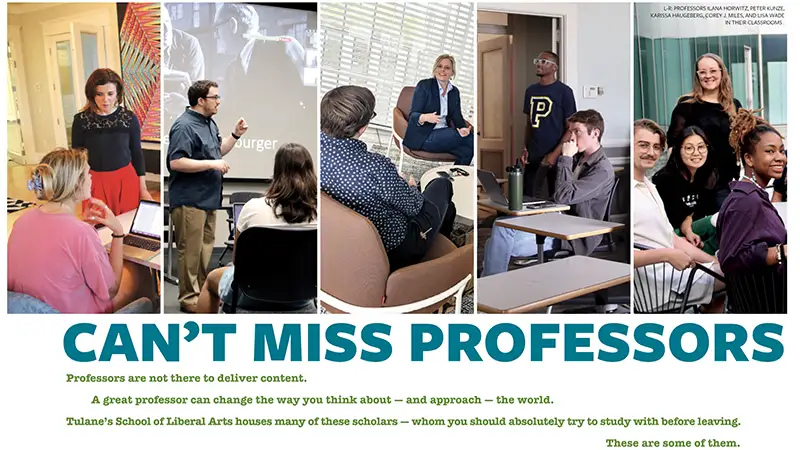
2024-03-20
SLA Professor Awarded $88,000 NSF Grant to Explore Gender Dynamics in Cuban Media Piracy
Laura-Zoë Humphreys, an Associate Professor in Communication at the School of Liberal Arts, has been honored with the National Science Foundation’s (NSF) Cultural Anthropology Program Senior Research Award, securing more than $88,000 in funding. This grant will support Humphreys' ongoing research on Cuban media piracy—focusing on the impact of gender on the consumption and distribution of unauthorized global media within the island nation.
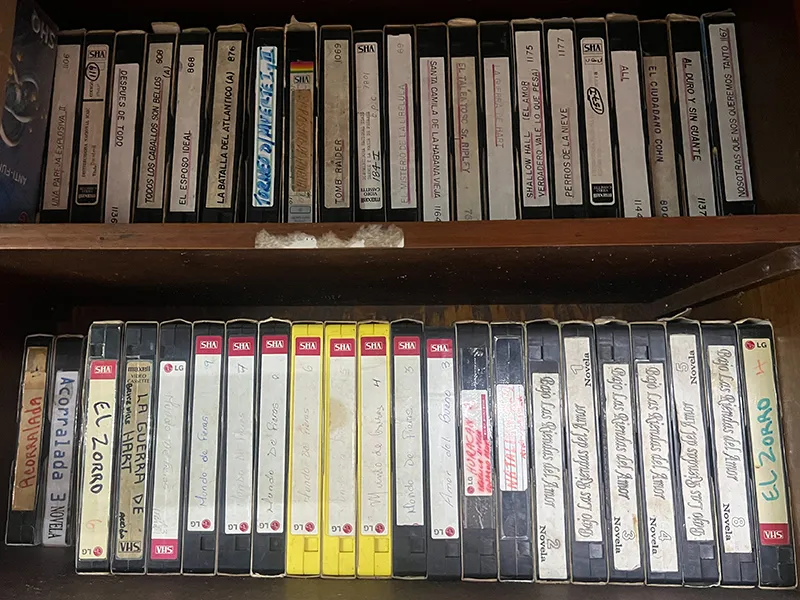
Humphreys has spent the last two decades studying Cuba, conducting research and living in Havana for months at a time. Her first book, Fidel Between the Lines: Paranoia and Ambivalence in Late Socialist Cuban Cinema (Duke University Press, 2019), shows how allegory and political paranoia shape the public sphere. Her current research is part of a second book project tentatively titled Waiting for the Copy: Gender and Media Piracy in Cuba. The project spans the history of media piracy in Cuba, from post-revolution stolen radio waves, through pirated satellite television and the VHS banks and salons of the nineties and early aughts, up into the digital contemporary landscape, where bundles, or “paquetes” of downloaded media travel the island on hard drives, circumvent the country’s limited internet infrastructure.
“There is a stereotype of Cuba being stuck in time or cut off from the rest of the world,” Humphreys says. “But what's interesting to me is that—while yes, they have had to struggle to gain access to it—Cuban people have always been immersed in global media flows."
Furthermore, Humphreys explains, in our current era—where streaming services dictate much of the world’s access to content—Cuban offline storage systems for pirated material have actually evolved into legitimate media archives.
In her research, Humphreys discovered the ways that gender shaped these informal media economies in terms of infrastructure, labor, and reception. During the nineties and early aughts, she found women who operated VHS banks from their homes to create informal means of living. Later, as media became digitized and piracy businesses were state-sanctioned, women were pushed out of male-dominated distribution networks. They remained, however, the media’s biggest consumers, particularly of pirated South Korean dramas, Turkish soaps, and Mexican telenovelas, which provided a lens for Cuban women to "reimagine race, romance, and capitalism."
The NSF grant will directly support various aspects of the research, and enable Humphreys to fund two Cuban research collaborators, Daymar Valdés Frigola and Sheyla Pool. Valdés Frigola, a Cuban film researcher and an archivist at the Cinemateca de Cuba, will join Humphreys in her fieldwork exploring the historical roots of media piracy. The Cuban sound engineer and film director Sheyla Pool will subsequently collaborate in producing bilingual podcast episodes alongside the research. The aim is to release the podcast through the book’s website and independent Cuban journalism sites, providing a public-facing dimension for both Cuban and international audiences. Throughout the project, Humphreys and her co-researchers are dedicated to preserving these unofficial histories of Cuban media, often reflecting significant political and historical moments, for the nation’s younger generations, and the rest of the world.
Humphreys has previously received a Wenner-Gren Post-PhD Research Grant and a Louisiana Board of Regents ATLAS award for related research. She now joins three other SLA faculty members with current NSF grants: Patrick Button (Economics), Brandon Davis (Political Science), and Katharine Jack (Anthropology).
Faculty
Pirated VHS tapes like these were often seized by Cuban police but then sent to state-operated video rental stores for "legal" consumption.
2024-01-24